A Commentary and Analysis by Selwyn Carter, Black Politics! —
As we accelerate toward the 2026 Fall midterms, the cable media tends to discuss the upcoming elections through a comfortable, worn-out lens: standard partisan competition, shifting congressional margins, and routine campaign theater. This way of portraying the election to voters is tantamount to an illusion. The 2026 midterm elections are anything but a normal political cycle. At Black Politics, we prefer to examine this electoral cycle from the perspective of standing directly on a structural fault line where the very mechanics of American democracy are being stress-tested, rewritten, and fought over.
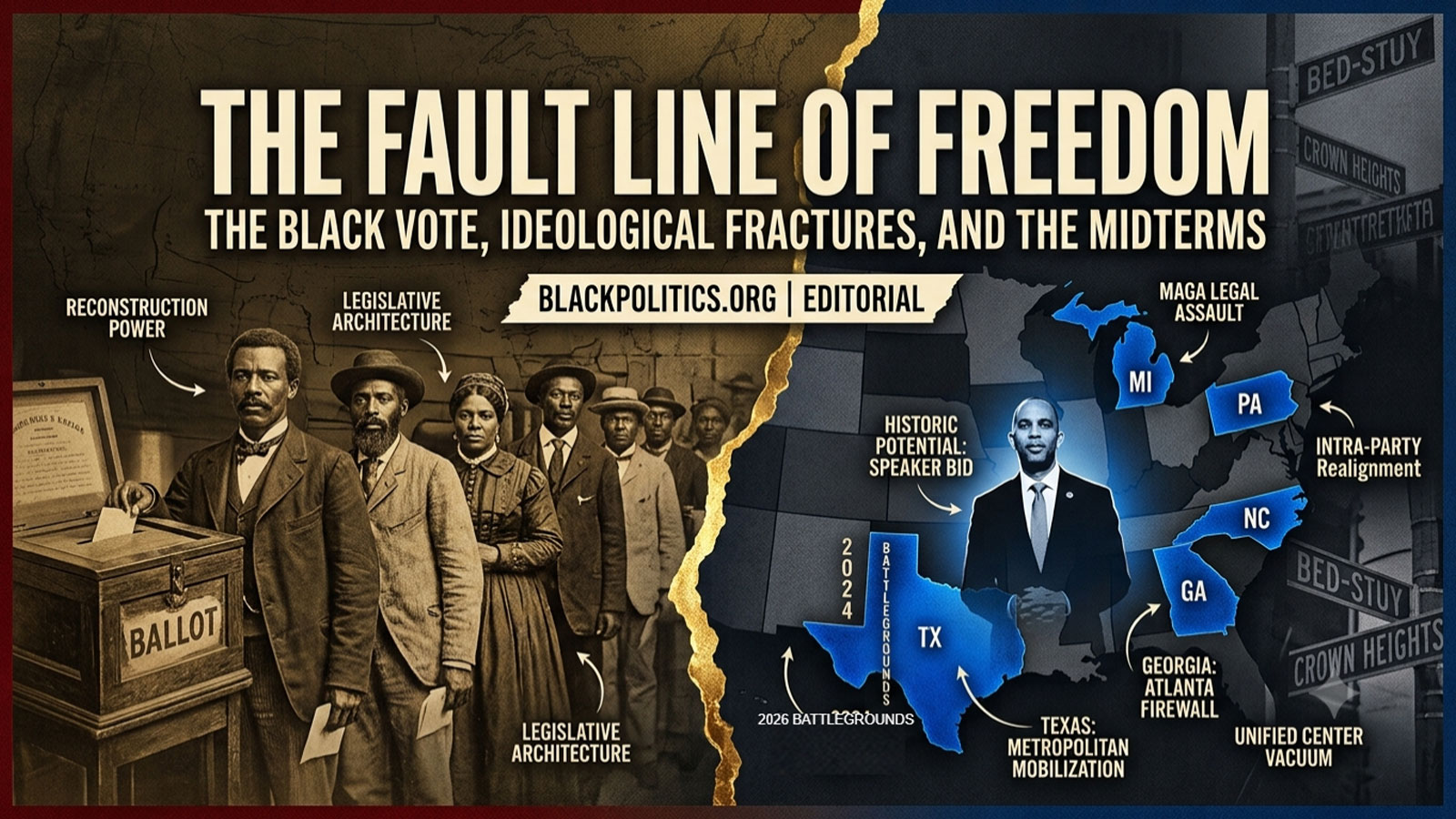
From Reconstruction to the 2026 midterms: Why the Black vote remains the ultimate battleground for American democracy
To map out how these competing forces are attempting to steer the 2026 midterms, we have to look past lazy campaign generalizations and examine the profound ideological fractures currently tearing through American political life. To understand why these forces are colliding so fiercely today, we must look to the past. As documented in our core archival framework on the Black Politics website, Black electoral politics has always been the gravitational center of American political life—not because it has ever delivered permanent solutions or liberation for African Americans, but because it was the one force capable of reconfiguring Southern society and achieving equality during Reconstruction. Consequently, it became the ultimate threat that white supremacists felt compelled to destroy and have perpetually sought to dismantle.
From the unprecedented legislative architecture built by Black majorities and coalitions in states like South Carolina and Mississippi during the 1870s, to the violent backlash of Post-Reconstruction constitutional sabotage (1890–1908), and through the fluctuating cycles of civil rights mobilization and systemic containment that followed, the Black vote has always defined the limits and possibilities of American democracy. Today, that historic fault line is under intense pressure once again.
1. The MAGA Movement and the Counter-Reformation on Voting
The conservative apparatus is engaged in a coordinated, multi-pronged assault on the mechanics of civic participation. Following recent prime-time battles over election administration, the Department of Justice’s emergency appeals to the Supreme Court are aggressively targeting mail-in voting.
This current legal assault directly seeks to undermine and dismantle a major legislative victory achieved by progressive forces over thirty years ago: the National Voter Registration Act (NVRA) of 1993 (the “Motor Voter” law), which expanded registration access and protected mail-in participation for millions of working-class and voters of color. When combined with federal push-backs like the “SAVE Act” and aggressive, targeted voter roll purges orchestrated by the right-wing Trump administration and aligned Republican state officials across key battlegrounds, these administrative measures are explicitly designed to alter electoral math by suppressing the participation of low-income and voters of color—a strategy meticulously documented in our ongoing tracking of structural voting restrictions.
2. The Left Lane, Gentrification, and the Disconnect in Brooklyn, NY
The pressure on the electorate isn’t just coming from the right wing. Within the broader coalition, the rise of the Democratic Socialists of America (DSA) and progressive insurgents are aggressively challenging establishment moderates—highlighted by high-stakes primaries in industrial battlegrounds like Michigan, where the intense Democratic Senate primary pitting progressive insurgent Abdul El-Sayed against establishment-backed Haley Stevens has exposed a sharp rift. As Black voters emerge as a critical voice in the race, many are expressing deep skepticism toward the progressive wing, driven by both pragmatic concerns about electability and lingering frustration with the progressive left’s positioning during the 2024 primary cycle—including the ‘Uncommitted’ movement’s aggressive challenge to Kamala Harris.
This friction points to a deeper, structural irony regarding who holds power on the left. Over successive election cycles, heavy outside spending by groups like AIPAC has systematically targeted and unseated prominent Black progressive members of Congress—from Cynthia McKinney years ago to Cori Bush and Jamaal Bowman more recently. Yet, as institutional pathways for Black progressive leadership have faced millions in targeted removal efforts, the vacuum is increasingly being filled by non-Black DSA progressives. This dynamic exposes a stark contradiction: while well-funded external apparatuses prune away historic Black political representation, the emergent insurgent left often marches into those very spaces with little regard for the foundational Black electorate that keeps the party viable.
Yet, this leftward shift has revealed a glaring cultural and political disconnect. A stark illustration occurred just weeks ago in Brooklyn, New York, following primary victories by DSA candidates. When Hakeem Jeffries’s name appeared on a television screen during a victory celebration, an overwhelmingly white crowd of activists broke out into a chant: “You’re Next”—a direct warning implying that he is next in line to be politically targeted, defeated, or ousted from power.
The presence of an all-white progressive activist base celebrating in the heart of historic Black communities like Bedford-Stuyvesant, Crown Heights, and East Flatbush is a direct product of relentless gentrification. At the same time, the passing of foundational institutional leaders like Al Vann and John Flateau, alongside the decline of the Coalition for Community Empowerment, has created an organizational vacuum. This institutional decay explains how chants that would have been unthinkable a decade ago now surface as cable news talking points. It underscores a fundamental crisis: the absence of cohesive Black electoral formations and a unified center capable of speaking for and to the Black community.
3. Hakeem Jeffries, the Speaker Bid, and the Balancing Act
As Democrats eye the House majority in 2026, Hakeem Jeffries stands at the center of a historic and precarious balancing act. For the first time in American history, the pathway to controlling the chamber carries the real possibility of elevating the first African American Speaker of the House.
Yet, managing the competing demands of moderate institutionalists and an increasingly aggressive progressive wing—while maintaining a unified front against a disciplined conservative opposition—is an unprecedented tightrope walk. Incidents like the Brooklyn chants put these factions sharply at odds with the Black electorate, which recognizes that historic legislative leadership should be a source of community leverage, not a target for ideological purists.
4. The Left, the Radicals, and the Reality of Party Power
This dynamic highlights a broader strategic contradiction on the American left. While historical remnants of the Black Radical Left have long mostly dismissed electoral politics as a compromised trap, a different phenomenon is playing out inside the institutional arena. Through groups like the DSA, the progressive left is no longer content with merely agitating from the sidelines; they are actively making a play for the party’s leadership, its center of gravity, and institutional leadership positions.
Yet both of these groupings—the sectarian left that abandons the electoral arena and the insurgent left attempting to capture party machinery—need a sharp reminder of political reality: Black voters are the undisputed base of the Democratic Party. You cannot lay claim to party leadership or chart a viable progressive future while ignoring or alienating the foundational constituency that keeps the coalition mathematically viable. By retreating from the electoral arena and dismissing the mechanics of voting, the sectarian left is effectively abdicating responsibility—yielding ground and political leadership to external forces outside the Black community within an arena where Black voters make up the ultimate body politic. To correct this historical contradiction, these elements would do well to restudy the practical wisdom of Malcolm X, who repeatedly stressed that political power requires mastering the use of the ballot rather than abandoning it to others.
5. The Illusion of the Token Candidate and the Florida Governor’s Race
At the same time, the Black community is neither confused nor misled by surface-level representation engineered by the right. In Florida, as the gubernatorial primary race unfolds for an open seat, high-profile figures backed by Donald Trump—such as U.S. Representative Byron Donalds—are attempting to claim the mantle of leadership.
Yet, a candidate’s skin color does not substitute for a platform that serves the material needs of Black people. Donalds neither speaks for the Black community nor champions policies addressing its core survival. On the contrary, his congressional voting record—spanning fiscal austerity, the dismantling of safety nets, and opposition to civil rights protections—runs directly counter to the interests of Black voters.
Complicating the Florida landscape even further is the independent run of Desmond Meade as a No Party Affiliation (NPA) candidate. As the president of the Florida Rights Restoration Coalition and the architect behind the historic 2018 Amendment 4 ballot initiative—which restored voting rights to over 1.4 million returning citizens—Meade represents an organic, grassroots tradition of civic power that stands in sharp contrast to partisan posturing.
Conclusion: African American Mobilization as the Decisive Factor
Because the Black vote is internally diverse and currently operates without a monolithic command center, its collective impact is defined entirely by mobilization. Where turnout surges across key regional fault lines—from the urban-suburban firewall in Georgia, to open-seat battles in North Carolina, post-primary alignments in Michigan, urban centers in Pennsylvania, and metropolitan mobilization in Texas—it remains the pivotal force determining the outcome of both Senate and House control.
When access to the ballot box is treated as a federal bottleneck—and when radical reconciliation packages systematically target the social safety net, Medicaid, and the ACA—the choices facing our communities are stark. Whether defending historic legislative gains, navigating internal ideological fractures, or pushing toward unprecedented congressional leadership, the historical cycle continues. The arena is contested, the fault lines are active, and the mobilization of the Black vote remains the definitive variable of the 2026 midterms.
To dive deeper into the historical roots, data archives, and strategic frameworks driving these insights, we invite you to read our complete editorial backgrounder, Why Black Electoral Politics Is the Fault Line.
Originally published by Black Politics!