The story of Ancient Egypt’s enduring and innovative civilization has been uprooted from the memory of African People. — Chester Higgins, Sacred Nile
As we read and meditate on our shared history and cultural experiences and on books, art, and images we see, these meditations leave imprints in our dreams and become part of our personal consciousness; however they do not become firmly etched in our memories until we find ways to connect them to past and present experiences, to the places we visit, and to the people with whom we interact. Traveling to Egypt had always been on my bucket list, and when I formally retired, I determined that I would take this journey. Plans to make this journey during the first year of my retirement came unexpectedly.
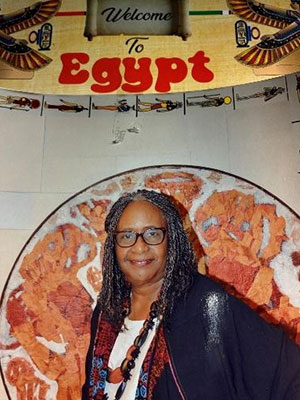
Dr. Brenda M. Greene
I had just visited the Flight into Egypt: Black Artists and Ancient Egypt, 1876-Now exhibit at the Metropolitan Museum of Art with two of my friends. As we were on our way back home, my friend said an email announcing a 10-day tour to Egypt with a three-night cruise on the Nile had just popped into her inbox. This was synchronicity in the making; I began to envision the fulfillment of my trip to Egypt. We had an option to take the trip in fall 2025 and decided that making this journey would be a great way to celebrate our birthdays which would occur respectively in October and November. We had been members of the young adult division of the National Association of Negro Business and Professional Women’s Clubs in the 1970s and collectively embarking on a trip five decades later would be a full circle moment for us. Fast forward, we recruited five others for the trip and on November 15, seven Black women left for Cairo, Egypt. We became part of a racially and ethnically diverse tour group that included us (seven professional Black women), two Chinese couples, one Korean couple, one White couple, and one White woman. Our tour guide was an Arab Egyptologist who motivated us to connect with each other by telling us that we would be his family for the next ten days.
Like many, my initial impressions of Egypt and the continent of Africa while growing up in the 1950s were formed by Hollywood. My knowledge of Egyptology and Ancient Africa evolved as I began to read scholarship on African history, art, religion, and philosophy while in college and over my years as a university professor and scholar in Black literature and culture. I had read and researched scholars who included Chancellor Williams, Anthony Diop, Ben-Jochannan, John Henry Clarke, John Mbiti, Clinton Crawford, and Chester Higgins among others. I also worked in and visited the Brooklyn Museum of Art where I had an opportunity to view and study the museum’s extensive collection of Egyptian artifacts. The information that I gained from reading and digesting scholarship on Ancient Africa and Egyptology was stored in my memory; however, the content of this scholarship did not excite my intellectual consciousness and impact my emotional consciousness until I visited and witnessed the majestic pyramids, temples, colossal stone Gods, and Ancient Egyptian deities in all their original splendor. Viewing the pyramids, tombs, and temples up close and observing firsthand the encryptions, hieroglyphics, and detailed drawings on the walls of the tombs and temples touched my spirt and stirred my emotions. I could never have imagined being able to walk into the Great Pyramid of Giza.
-
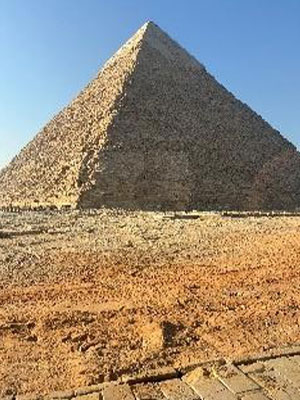
- Great Pyramid of Giza
-
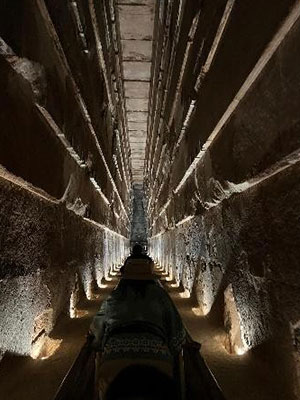
- Interior Stairway of Giza Pyramid
-
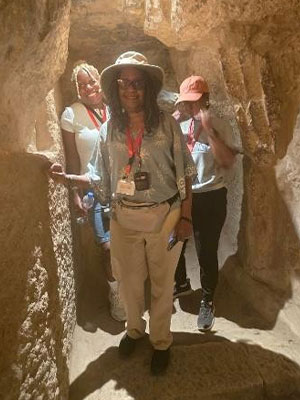
- Interior Stairway of Giza Pyramid
The Great Pyramid of Giza, located on the Giza Plateau on the west bank of the Nile River, was the home of the tomb for the Pharaoh Khufu. I was thrilled when our tour guide told us that we could visit the interior of this pyramid and view the Pharoah’s chambers. He described how we would enter a dark dimly lit stairwell that was used to transport the coffin of the King to the upper reaches of the chamber and emphasized that we should be prepared to spend at least half of our journey in a crouched position as we slowly climbed the narrow steep steps to the top of the chamber. He also warned us that if we were claustrophobic, we should definitely bypass this experience. I was not deterred. I had traveled over 5600 miles and crossed the Atlantic Ocean, the Mediterranean Sea, and the Red Sea to bear witness to the pyramids, tombs, and temples of Egypt. There was no way that I would back away from going into the interior of the pyramid and viewing the empty sarcophagus that laid in the King’s Chamber. Climbing the steps up to the Chamber in the hot stairway was challenging but a highlight of the trip. I had endured and persisted and created an emotional and intellectual memory that will forever be etched in my mind.
Many Ancient Egyptian tombs and temples are guarded by statues who serve as sentries and contain artifacts that include sculpture, jewelry, beds, and personal items that have been part of the burial sites of Egyptian kings for over 500 years. The wide range of statues and temples was unimaginable and I realized that this was only a part of Ancient African civilization. There were also pyramids, temples, and tombs in Ethiopia and the Sudan. So much of African history was not known or was portrayed from the perspective of the colonizer. We asked ourselves: Why wasn’t this knowledge an integral part of what we had studied in world history courses? Why were we still seeing images in film and on television that did not reflect the temples, monuments, and images of Ancient Africa that I saw in Egypt?
-
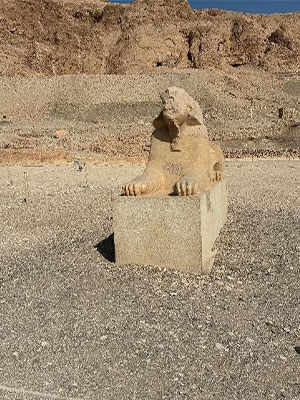
- Statue with Head of Human and Body of a Lion
-
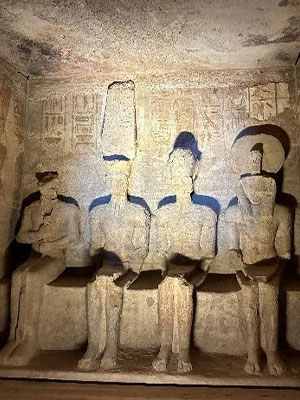
- Temple at Abu Simbel
-
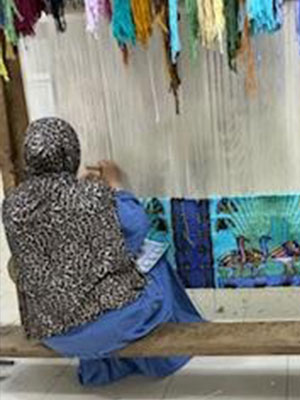
- Woman Working on Carpet at Akhnaton Carpet School in Giza, Egypt
Having read scholarship on Western attempts to deny the Black origins of Ancient Egypt, I listened to the tour guide’s talks and presentations on the history, purpose, and construction of the pyramids and temples we visited with a sense of tentativeness. The tour guide had indicated that he was an Egyptologist, but I was not convinced that he had done the research and read the texts I had read. When we first began the tour in Cairo, I asked him when were we going to see the Nubians of Egypt. His response was vague in my view. He informed me that the Nubians lived closer to the Sudan which was south of Egypt. He was not prepared for this question and the next day he gave the group a little more detail on the divide between upper and southern Egypt. To be clear, he had not engaged in resisting what Toni Morrison refers to as the “white gaze” in his discussion of Ancient Egyptian history, temples, tombs, images, and rituals. While he fascinated many in our tour group with stories and descriptions of the images depicting sacrifices, burial practices, and birthing rituals on the walls of temples and tombs, described the Egyptian belief system, and explained how the temples were excavated, he limited discussion on theories of how Egyptians had gained this knowledge and on the relationships between the Egyptians of Cairo and the Nubians.
My desire to see the Nubians in Egypt was fulfilled when we embarked on the three-day cruise on the Nile. We had lunch at a Nubian restaurant and boarded the ship in Aswan where many Nubians live. On the first evening of our cruise, we were asked to wear a Nubian or Egyptian outfit to a welcome Galabiya Party organized by the Nubians and on the second night we watched a musical and dance performance by the Nubians. As the only Black tourists on the ship, we stood out and the Nubians called us cousin, welcomed us, and encouraged us to join their performances. At the end of both evenings, we closed out the night dancing to the drumming of the Nubian musicians; those of us who had taken African dance lessons demonstrated our traditional dance moves for our Nubian hosts. As one might imagine, the seven of us were the highlights of both evenings. A missing piece for me before we boarded the ship in Aswan was that I had not had an opportunity to interact with the local people and to participate in cultural activities. Until we boarded the ship on the Nile River, this tour had been very different than my trip to Ghana in the 1970s. While in Ghana, we went to villages, observed local people practicing rituals, danced in community celebrations, and had an opportunity to immerse ourselves in the culture. Thus, as a result of the Nubian celebrations on the ship, the cruise on the “Sacred” Nile River ended up being another highlight of the trip. It was a peaceful and spiritually uplifting experience that brought back memories of my trip to Ghana and added a much-needed cultural component to our trip.
The Grand Egyptian Museum (GEM) in Cairo, Egypt which reopened on October 27, 2025 after three decades of being closed for renovation culminated my journey to Egypt. We only had three hours to explore this massive museum with a pyramid shaped entrance, 12 galleries and over 100,000 artifacts. This impressive collection also housed in one place, 5000 treasures and artifacts from the tomb of the Boy King Tutankhamun.
A backdrop to the reopening of GEM is Egypt’s request that artifacts taken from the country during its colonization by Western countries such as England, France, and Germany be returned. Of particular interest are the Rosetta Stone whose inscriptions in several languages and scripts provide an understanding of hieroglyphic writing, the Dendera Zodiac, an artifact depicting Ancient Egyptian astronomy, and the Nefertiti Bust, a painted stucco-coated limestone bust of Nefretiti. The Rosetta Stone is currently housed in the British Museum, the Dendera Zodiac is at the Louvre, and the Nefertiti Bust is at the Egyptian Museum in Berlin. UNESCO has rules that artifacts acquired illegally belong to the country of origin. However, there is no way to enforce this rule. Thus, ultimately Egypt is faced with relying on each country’s decision on whether it will return the items. In the view of many, these decisions raise the ethical and moral issue of whether countries that colonized Africa correct “a wrong” and return artifacts which they took during the occupation of another country? We have confronted the issue of “stolen” or “confiscated” African artifacts is in the United States and several museums have returned objects acquired during the colonization of the African countries of Uganda and Ghana.
-
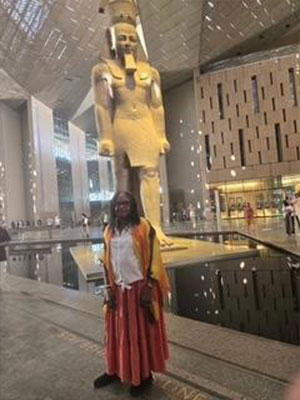
- Statue in Grand Egyptian Museum (GEM)
-
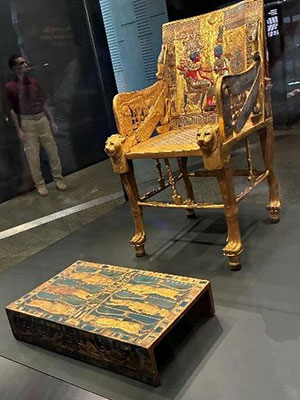
- Royal Chair in King Tut Artifacts (GEM)
-
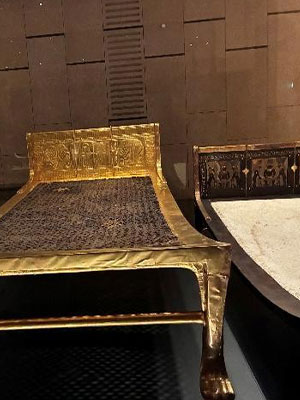
- Royal Bed in King Tut Artifacts (GEM)
-
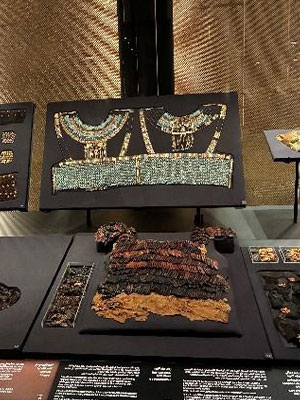
- King Tut Jewelry (GEM)
-
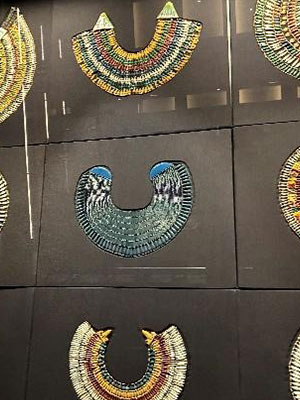
- King Tut Jewelry (GEM)
-
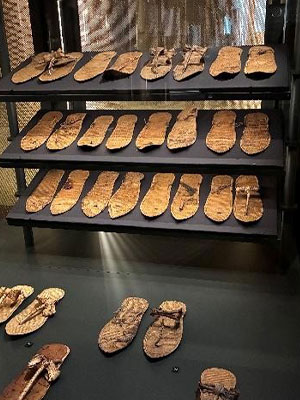
- Sandals from King Tut’s Tomb (GEM)
My journey to Egypt was finally over and I had more questions than answers; this is probably a good outcome. The photos I had taken were starting points for delving into more details on the history, theories, religion, and culture of Ancient Egypt. I proceeded to listen to videotapes on theories of how the pyramids were developed and to research information on landmark sites we had visited: Abu Simbel, the Valley of the Kings, the Giza Complex, and the Luxor Temple.
-
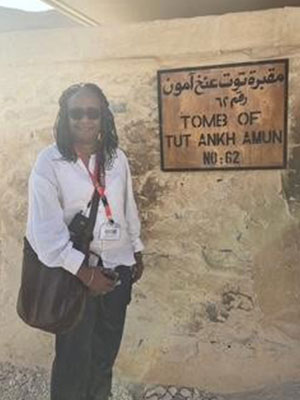
- Tomb of Tut Akh Amun
-
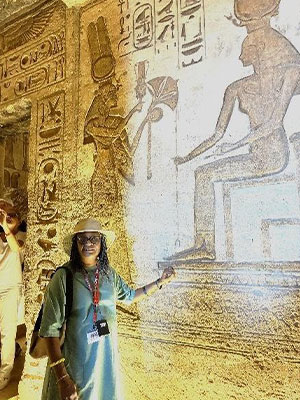
- Inside Temple at Abu Simbel, Aswan
I had read Sacred Nile, Chester Higgins’ comprehensive and beautifully rendered photographs that document his journeys to Egypt, the Sudan, and Ethiopia over the last 50 years, and I was motivated to go back and view these photographs and his story. This helped to deepen my research and cultural and spiritual knowledge of Ancient Africa and aided me in connecting the dots and adding substance to the vague memories of African history and religion that were imprinted in my mind.
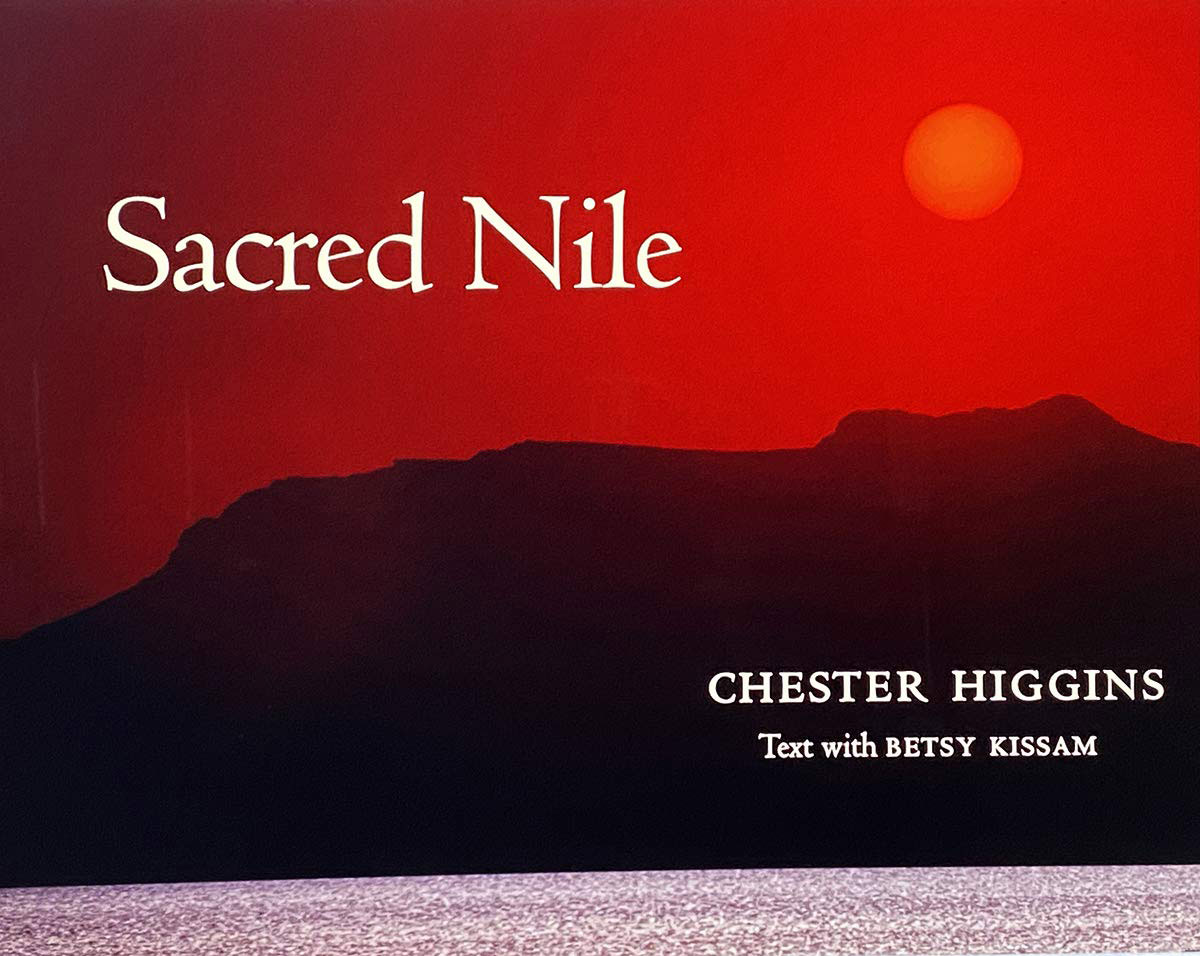
Sacred Nile by Chester Higgins (Photographer)
Higgins opens Sacred Nile by reminding us that the debate on the origins of African Civilization continues to be part of our intellectual thought. His gripping photographs capture the soul of the people and natural landscapes and provide an integrated way to examine nature, spirituality, culture, and religion in Egypt, Ethiopia, and the Sudan. They provide a Black lens for shaping our knowledge of Ancient Africa. In using nature, spirituality, culture, and religion as a framework from which to understand the African origins of civilization, Higgins provides a broader and more complicated vision of the history and evolution of Ancient Africa and its impact and role in contemporary society. He argues that the origins of African Civilization necessitate the study of how astronomy impacted the design of the pyramids and of how the flow and characteristics of the “Sacred” Nile River helped to address the needs of farmers, workers, and kings and to shape spiritual, and religious traditions, practices, and experiences in Egypt, the Sudan, and Ethiopia. My in-depth YouTube interview with Chester Higgins on Writers on Writing adds a substantive description of his research on Ancient Egyptian history, religion, and hieroglyphics.
After going back and rereading Higgins’ book, I am motivated to conduct further investigations into questions such as: what the hieroglyphics on the walls of pyramids reveal about theological concepts of the spirit, soul, resurrection, ascension, and a celestial afterlife and how the origins of Christianity, Judaism, and Islam complement each other. I also realize that this will be a process. Higgins has spent the last 50+ years studying Ancient African religion, spirituality, culture, and nature.
The epigraph at the beginning of my reflection on this Egyptian trip highlights Chester Higgins’s message that the story of Ancient Egypt’s enduring and innovative civilization has been uprooted from the memory of African People. This trip has inspired me to work towards ensuring that our communities, my grandchildren, and future generations of children study Ancient Egypt. We must be intentional about developing innovative and creative ways to impart this knowledge to our families and friends and in our classrooms and university and public spaces.
Dr. Brenda M. Greene
Professor Emeritus, Department of English and World Languages
Executive Director Emeritus, Center for Black Literature
Medgar Evers College, City University of New York
www.drbrendamgreene.com