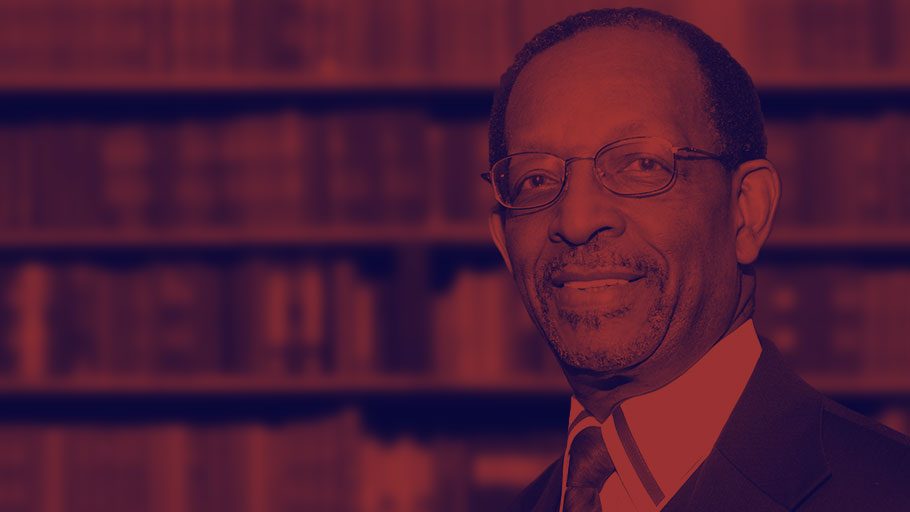
An Authentic “Race Man”. Celebrating the Life and Legacy of Dr. James Turner
Vantage Point by Dr. Ron Daniels —
 Four decades ago at the height of the Black Consciousness and Black Power Movements, the National Council of Black Studies was founded as a mechanism to ensure the character and quality of Black Studies Programs that were being created at colleges and universities across the nation in response to demands of Black students. As a direct outgrowth of the movement for dignity, justice, equality and empowerment of Black people, the vision/mission of Black Studies was “education for liberation.” Therefore, a central focus of Black Studies was to address the “mis-education” of students of African descent by providing a critical understanding of their history and culture, an African-centered framework for examining the world, and the knowledge and tools to become change agents for an oppressed people. One of the visionary architects and leaders of this movement was a gifted young scholar-activist, Dr. James Turner, Chairman Emeritus of the highly acclaimed Africana Studies and Research Center at Cornell University.
One of the highlights of the 35th Annual Conference of the National Council of Black Studies was a Plenary Session honoring Dr. Turner, chaired by Dr. Alan Colon of Dillard University. The session was entitled: James Turner, Africana Studies and the Making of the Discipline. I was honored to join former students Dr. Scot Brown, UCLA, Professor Kimberle Crenshaw, UCLA/Columbia and long time friends/associates Dr. Delores Aldridge, Emory University and Dr. James Stewart, Penn State University in paying tribute to the life and legacy of this pioneer of the Black Studies movement and one of the most formidable intellectuals (action-oriented theorist) of the last half century. At a time when Black/Africana Studies programs are being dismantled, demoted or absorbed, it was an opportune occasion to reflect on the legacy of a scholar/activist whose ideas and praxis provided crucial underpinnings for the discipline.
My remarks on this auspicious occasion were offered through the prism of my relationship with a close advisor, confidant, friend, brother and comrade in struggle for more than four decades. Virtually every major decision about my life´s work as a scholar/activist and organizer has been made with the advice/counsel of Dr. James Turner, a Brother who has relentlessly and uncompromisingly utilized his enormous talents for the uplift of the race. In that vein, I recall a conversation about the “state of the race” we had some years ago during a visit to Cornell in which he suggested that what we need are more brothers and sisters who will be “of the race and for the race.” He noted that we now have an unprecedented number of Black people with a wide range of skills, talent and resources, but far too many lack the consciousness and commitment to use what they have to advance the race. For as long as I have known Dr. James Turner he has been “of the race and for the race,” an authentic “race man” in the finest sense of the term.
Dr. Turner´s racial consciousness was forged early in life. The son of what he describes as a “laboring class” family, he grew up in the housing projects in lower Manhattan, New York. The experience of growing up in a close knit family struggling to subsist and improve their quality of life left an indelible impression on him, not the least of which were a deep and abiding respect for the strength and
resiliency of Black poor and working people and the importance of community. Though the Turner´s abode was “downtown,” he was but a subway ride from Harlem, the Capital of Black America. Here he would avail himself of the opportunity to bathe in the multidimensional culture of the post Renaissance period, listen to street corner orators excoriating white supremacy and calling for the “redemption of the Negro people of the world.” One such orator was Minister Malcolm X, whose incisive analysis and spellbinding orations would have a lasting impact on a young mind thirsty for knowledge. Equally important, James Turner would have the privilege of sitting at the feet and being mentored by some of the great “race men” of the era, including the incomparable Dr. John Henrik Clarke.
I site this background and these experiences because they would shape James Turner´s sense of purpose in life and his vision of the mission of education for the sons and daughters of Africa in America, particularly what was taught in the academies of higher learning. Early on, James Turner decided that no matter what his station in life, he must be committed to “return to the source,” to be immersed in the Black Freedom Struggle to liberate the masses of Black people from racial degradation, political repression and economic exploitation. From this stance it was only logical that he would view the demand for Black Studies as an extension of the Black Freedom Struggle.
When Black students at Cornell seized Willard Straight Hall in April of 1969 as part of a movement to protest conditions on campus, they demanded the creation of a Black Studies Program to make the curriculum more relevant to the interests of Africans in America and the nation. When the administration acceded, Black students, who had heard James Turner articulate his vision of education for liberation at a conference at Howard University, selected him to develop the Africana Studies and Research Center at Cornell. From that vantage point Dr. James Turner aggressively and skillfully began the task of erecting an institution that would mirror the concept of education for liberation and thereby become a model for similar programs/departments which were springing up across the country.
The first charge was to make clear to students, faculty and the administration that Black Studies was not simply a short term add-on to the curriculum as a concession to protest but an emerging discipline with a focus on innovative teaching, stellar research and outstanding scholarship. The objective was to produce critical thinking scholar/activists equipped with the knowledge, consciousness and commitment to be of service to the Black community at some level. True to his vision of the academy connected to the community, Dr. Turner worked tirelessly to make the Africana Studies and Research Center (AS&RC) a resource for Black students on campus(whether they were enrolled in classes or not), the Black community in the city of Ithaca, Black America and the Pan African World. Faculty, students and staff from AS&RC were often engaged in providing support for community development initiatives in Ithaca and on the front lines side by side with residents when issues or struggles of vital concern to the community emerged. Under Dr. Turner´s leadership AS&RC became a place/space where leading scholars, activists and organizers gathered to informally analyze the state of the “movement” and discuss strategies for impacting the Black community. At a more formal level, for years, AS&RC convened annual State of Black America Conferences where students and community leaders from across the nation would come to take stock of the state of the Black condition in America and the world and debate how best to advance the interests and aspirations of Black people.
In addition, time and time again Dr. Turner strategized to find ways of utilizing the resources of AS&RC to support various struggles in Black America and the Pan African World, most often by bringing leaders of various movements to Cornell to deliver lectures or conduct workshops or by sponsoring significant events in various locations around the country. When The Honorable Minister Louis Farrakhan was contemplating rebuilding the shattered Nation of Islam, on more than one occasion, Dr. Turner invited him to lecture at Cornell. The lectures also provided an opportunity for Minister Farrakhan and Dr. Turner to share ideas about rebuilding NOI. The Harambee Singers of Atlanta, who needed support sustaining the Pan African Work Center, were also frequent performers at Cornell.
Dr. Turner consciously sought to make AS&RC an intellectual refuge for movement activists/freedom fighters, a place for them to acquire additional data/information to inform their work, refine their skills and retool to better engage the struggle on the frontlines. Taking note of the fact that James Forman, who served as Chairman of SNCC during the historic Mississippi Freedom Summer of 1964, was virtually a forgotten figure to the younger generation, Dr. Turner arranged for him to matriculate at Cornell where he secured a degree in Africana Studies. Forman went on to receive his Doctorate at the Union Graduate School. His stint at AS&RC revived his stature as a venerable freedom fighter. When Cynthia McKinney lost her seat in Congress after a malicious campaign, there was a space at AS&RC to share her knowledge and experience with students. When a battle scarred Ron Daniels needed respite from the tensions and conflicts of the movement, I was able to bring my academic credentials and lived experiences to teach Black Social and Political Thought and Political Economy of Black America. In one of the most rewarding experiences of my life, I was able to interact with amazing students like Professor Kimberle Crenshaw. And, like Minister Farrakhan I was able to take advantage of time spent at Cornell to receive invaluable counsel and support from Dr. Turner.
Because of his pioneering role in founding the Black Studies movement and selfless utilization of the human and material resources of AS&RC for community development efforts, Dr. Turner is one of the most trusted scholar/activists in the movement. As such he was called upon to Chair and coordinate the North American Delegation to the Sixth Pan African Congress in Dar Es Salaam, Tanzania in 1974. This was no easy task because of the range of brilliant minds, prominent movement leaders and divergent ideological views among the participants. Under these circumstances, there was consensus that the leader for such a challenging task was Dr. James Turner. In that same spirit, as Chairman of the National Malcolm X Commemoration Commission, he was able to marshal the energy, enthusiasm and experience of community based organizations and leaders across the country to make 1990 The Year of Malcolm X a milestone success.
Dr. Turner is not only a trusted leader, he is widely recognized as one of the most brilliant analysts and lecturers of our time. Few scholar/activists can break down complex ideas and convey them to an audience with incisive insights and popular/understandable language like Dr. James Turner. He is a master at the podium, a progressive, African-centered analyst, advocate and activist who uses his roots in family and community to connect with, inform and inspire sisters and brothers from all walks of life to be “of the race and for the race.” If you want clarity on an issue affecting people of African descent in the U.S. or the Pan African world, movement folks know to call on Dr. James Turner.
As I remarked during the tribute to Dr. Turner at the NCBS Annual Conference, his legacy is enshrined in the multitude of students who have sat at his feet, the community struggles that have been empowered by his advice and support, the activists who have counted on and benefitted from his counsel and the institutions which bear the mark of AS&RC as a sterling model of education for liberation! He is an authentic race man!
It is ironic that as we gathered to honor Dr. Turner, the Africana Studies and Research Center at Cornell is under assault. Without consultation with faculty or students the administration recently unilaterally announced that AS&RC would cease to be recognized as an independent department reporting directly to the Provost. There is an obvious calculation by the administration that the time is ripe to curb the influence/power of AS&RC as a force for change on the campus, in the community and the academy nationwide. To permit this action to stand would be an affront to Dr. James Turner and all the faculty, staff and students who fought and labored diligently for decades to maintain this magnificent model for the world to emulate. In the spirit of education for liberation, we must engage the struggle to preserve this vital institution. Long live the legacy of Dr. James Turner!