The Institute of the Black World 21st Century (IBW, IBW21) and the Pan-African Unity Dialogue (PAUD) present the May 2026 Communiqué of the Mutual Solidarity and Engagement Fact-Finding Delegation to Cuba. Developed following the delegation’s May 26–30, 2026 visit to Cuba, the communiqué documents key observations, findings, and recommendations based on direct engagement with government officials, healthcare professionals, educators, and community leaders.
Download the Communiqué (PDF)Contents
• An Expression of Appreciation to Danny Glover and James Early →
• Purpose/Objective of the Delegation →
• What the Delegation Witnessed/Synopsis of Observations →
• Action Agenda →
- Mutual Solidarity Assistance →
- Normalizing Relation with Cuba Based on the Obama Accords
Political Education, Mobilization and Engagement the U.S. →
• May 2026 IBW/PAUD Delegation →
An Expression of Appreciation to
Danny Glover and James Early
We would like to begin this Communique from the historic Institute of the Black World 21st Century (IBW) and Pan African Unity Dialogue’s (PAUD) Emergency Delegation to Cuba with an acknowledgement and salute to Danny Glover, who Harry Belfonte called the Paul Robeson of our era. Mr. Belafonte, who in his own right lived his life in the tradition of Paul Robeson, lovingly bestowed that title of his friend because Danny Glover intentionally, relentlessly and selflessly utilized his enormous talents and brilliance to serve and advance the aspirations of people of African descent and humankind. This was especially true as it relates to connecting with and supporting the aspirations of Afro-Descendant peoples in this hemisphere and progressive and revolutionary leaders and government. Danny Glover is a beloved figure who developed meaningful relationships with the likes of Fidel Castro, Hugo Chavez and Jean Bertrand Aristide to mention a few.
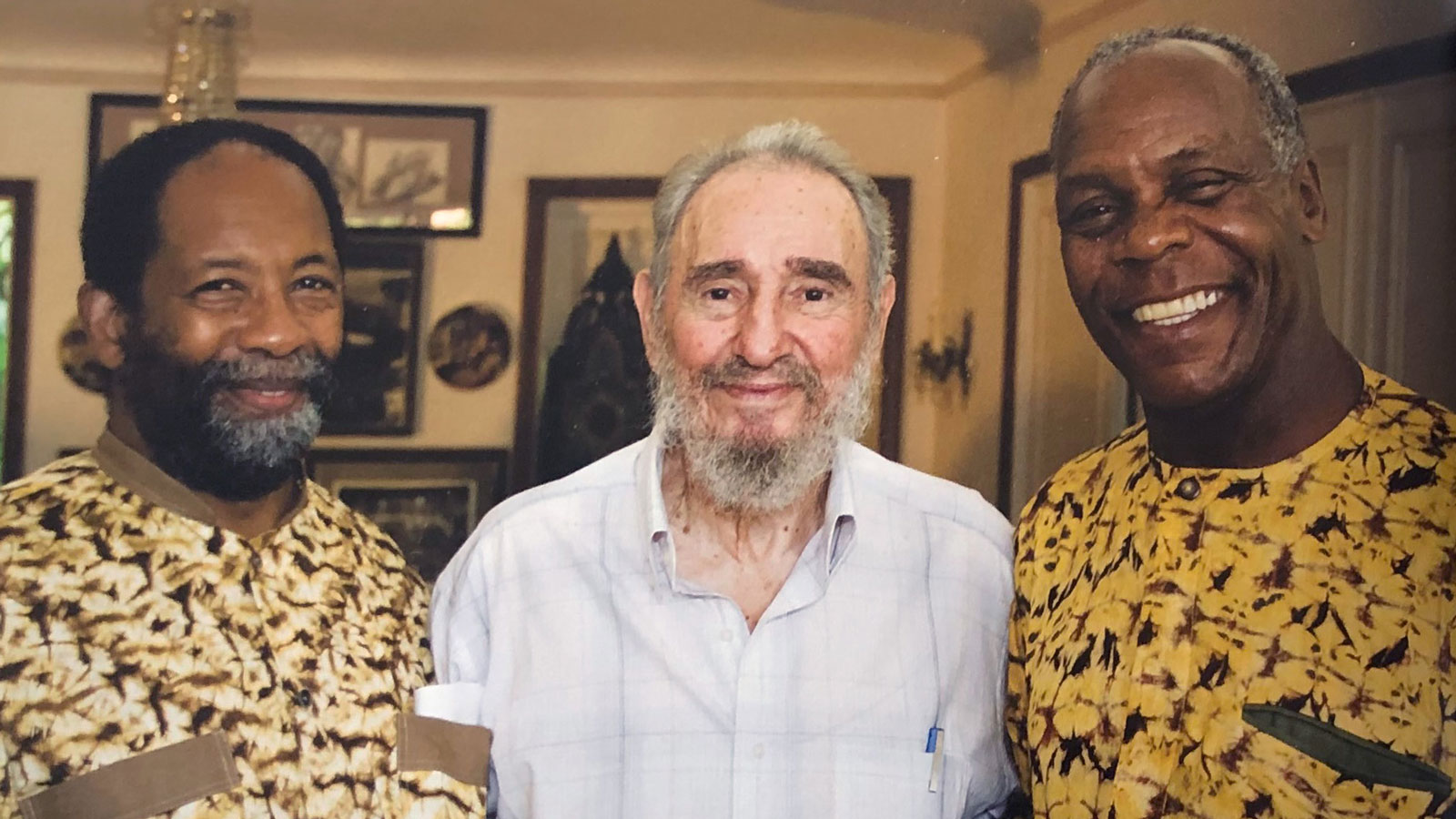
James Early, Fidel Castro and Danny Glover. Courtesy of James Early.
It is important to note that over the years at his side has been his beloved friend, thought partner and advisor James Early. James is a highly principled and brilliant thinker and policy advocate who has spent more than a half-century building relationships with educating about and advocating for Afro-Descendants, progressive and revolutionary leaders and governments in this hemisphere. Danny Glover and James Early have developed deep and principled relationships with the leaders and people of Cuba with a keen interest in the status and role of Afro-Cubans in Cuban society. It is fair to say that a Delegation of this character and magnitude would not have been possible without the thoughtful advice and facilitation of James Early. His own views and perspectives of the Cuban Revolution notwithstanding, James repeatedly urged Participants in the Delegation to ask questions about any subject or matter with whomever we might meet and to reach their own conclusions about any aspect of governance or the life of the people in Cuba. This encouragement was very useful given the composition of our Delegation. Therefore, an expression of appreciation is in order.
Back to Top ↑
Purpose/Objective of the Delegation
Given the longevity and deepening nature of the crisis in Cuba it was IBW/PAUD’s intent to assemble a broad-based delegation of influential civil rights, human rights, pan-Africanists, faith, business and professional and civic leaders, artists, cultural workers and journalists who would be eyewitnesses to conditions on the ground in Cuba. In that regard, a major purpose of the Delegation was to broaden and deepen the mutual solidarity and engagement movement with the twofold objective of enhancing the collective capacity for humanitarian assistance to alleviate the suffering of the Cuban people; and contributing to the building of a more robust civic education and civic engagement movement to end the devastating blockade and punitive sanctions. The Official Statement for the Delegation also declared: “Our message to the long-suffering Cuban masses is that help is on the way. In the words of the late, great friend of Cuba, Rev. Jesse L. Jackson, we have come to “Keep Hope Alive!”
Back to Top ↑
What the Delegation Witnessed
Synopsis of Observations
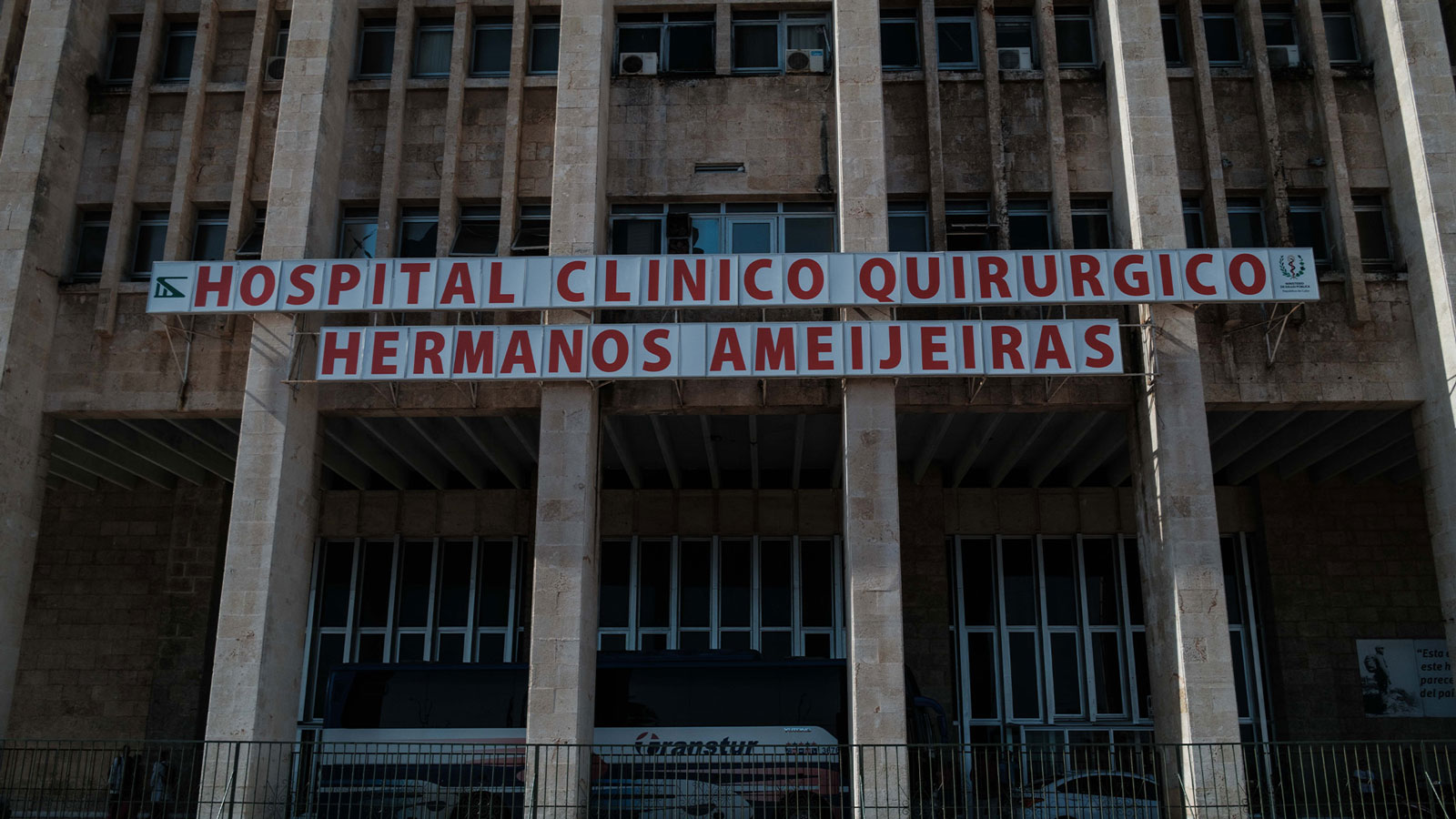
Hospital Clínico Quirúrgico Hermanos Ameijeiras in Havana, Cuba. Photo by Bill Lee.
The Delegation was aware of the Editorial Opinion Piece in the New York Times entitled: What We Saw Shocked Us: Cubans Deserve America’s Generosity, Not It’s Cruelty. It was included in the briefing materials prior to our departure. Reading about the suffering of the Cuban people because of the blockage and embargo on fuel is one thing, but witnessing it first hand is another matter. Imagine being without electricity for days, living by candlelight at night and having to purchase perishable foods on a daily basis to avoid items spoiling because of the lack of refrigeration. Time and time we were told about the demoralizing suffering due to lack of electricity by people from all walks of life, including our guides and leaders from the government and civil society.
But the cruelty was most evident in the medical sector. Imagine having to miss dialysis because of lack of electricity or having to miss or postpone an urgently needed operation for the same reason. Doctors told of the gut wrenching and traumatic decision of having to make choices between who might live or die because of the lack of medical equipment or essential medicines due to the embargo on fuel and blockade which prevents the receipt of medical supplies and equipment. Cuba’s infant mortality rate is among the lowest in the world, but it has increased dramatically because of the embargo and sanctions.
In one of the most poignant moments for the Delegation a doctor choked up and began to cry when asked about the impact of the embargo and blockade on his ability to properly treat his patients. What was also evident to the Delegation was the commitment, dedication and utter joy that doctors and medical professionals in Cuba have for serving the people. They exude a contagious pride of purpose in serving the people!
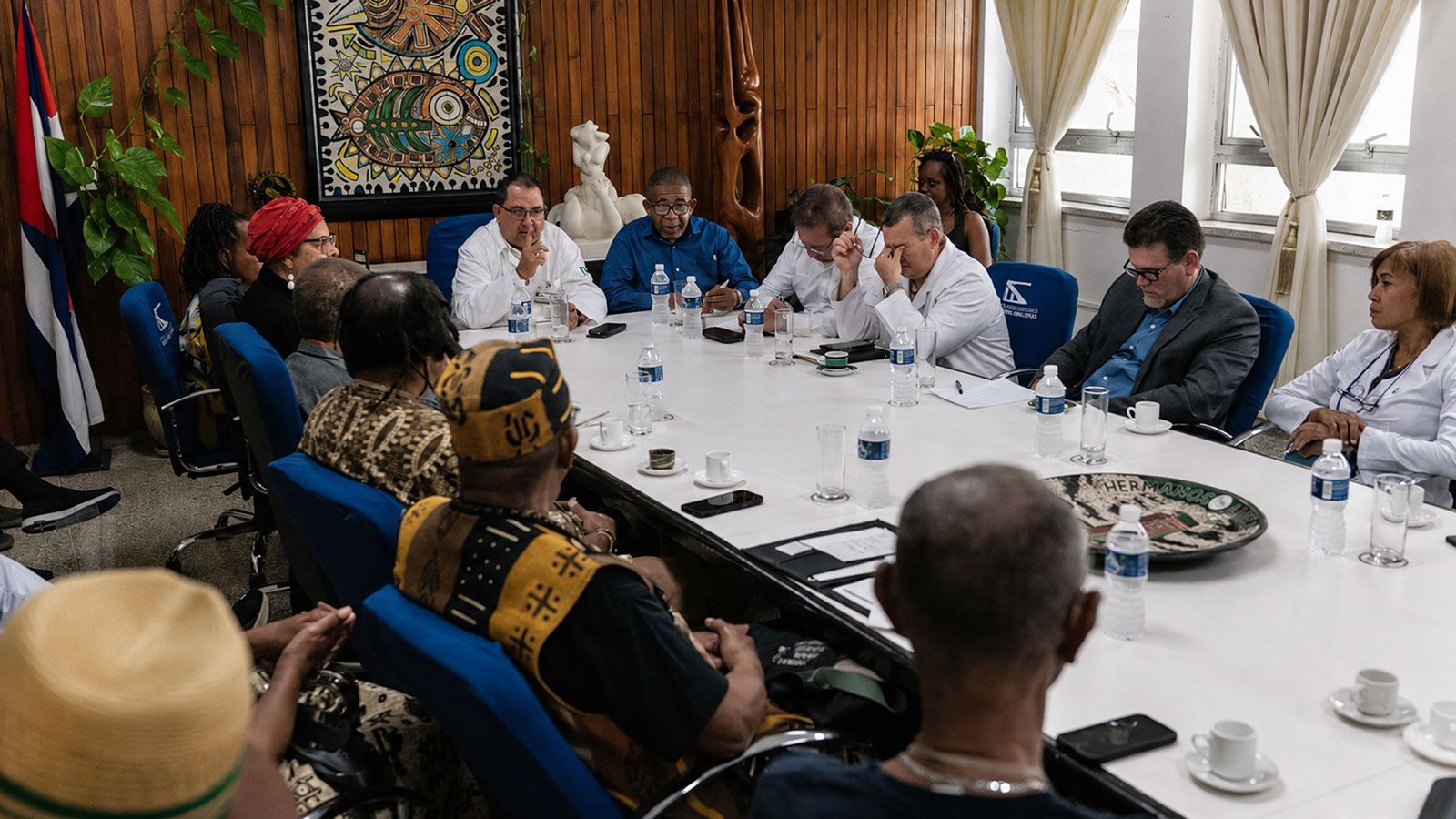
Delegation meeting at Hospital Clínico Quirúrgico Hermanos Ameijeiras. Photo by Bill Lee.
The once bustling streets in Havana were virtually empty as the cost of what little fuel is available, has skyrocketed to $40 dollars a gallon U.S. A few motorcycles and human powered taxis were servicing residents trying to get to work or to take care of whatever chores they could. Buses were idle and sanitation vehicles sidelined for lack of fuel leading to garbage piling up in some neighborhoods despite the efforts of community members to keep the streets clean. There was no place to put garbage because the neighborhood containers were overflowing; a perfect environment for rats and rodents to flourish and for disease to spread.
James Early, who has been visiting Cuba for nearly a half century observed that for the first time there were homeless people and beggars on the street, some children and pregnant mothers pleading with the few tourists that could be found for a dollar for food or the necessities of life. In one intense but respectful encounter with an Afro-Cuban Trump supporter, he recalled President Obama’s visit to Cuba at the invitation of former President Raul Castro. He said that life was much better after Obama normalized relations with Cuba. Tourists came in large numbers. The injection of dollars created opportunities for large numbers of people. With the repeal of the Obama accords and Trump’s imposition of an embargo on fuel, life has become virtually unbearable. It seems that the angry beggar was not so much a Trump supporter as a desperate human being who wanted Trump to invade, oust the government and end the embargo and the sanctions. He was likely the kind of unfortunate victim of U.S. policy that Trump is counting on to rise up and rebel against the government.
Nostalgia for the days of the Obama Accords as a preferred policy was referenced more than once during the Delegation. This is significant in terms of the Action Agenda advanced in this Communique. The Accords included several areas of cooperation between the U.S. and Cuba, one of which related to drug interdiction. President Obama did not endorse the Cuban Government but suggested that areas of disagreement should be discussed through diplomatic channels rather than contested by hostile acts. President Trump’s disdain for President Obama coupled with the strident demands from the powerful Cuban American lobby in Florida led him to sack the Obama Accords and pursue a more bellicose MAGA position. Hence the calculated effort to choke, to strangle Cuba into submitting to the will of Trump and his south Florida allies.
Governmental and civil society leaders, heads of agencies and institutions at all levels describe the current crisis as the most severe and damaging of the Revolution. But the spirit of resistance and resilience is strong. At the Karibuni Community Center we witnessed community organizers working with neighborhood residents to find ways to support each other in this moment of grave crisis. Spirits were high and a sense of defiance was evident. We experienced the same sentiment during our visit to the Martin Luther King Center which receives and distributes humanitarian aid from Pastors for Peace in the U.S. and other sources. An Altar honoring the memory of Rev. Lucius Walker, Founder of Pastors for Peace is prominently placed in the Center. Both institutions were continuing to educate and equip community residents to engage in mutual support despite the dire conditions resulting from the embargo on fuel and the sanctions.
Rev. Lucius Walker memorial altar at the Martin Luther King Jr. Memorial Center, Havana, Cuba. Photo by Bill Lee.
In our high-level meeting with H.E. Carlos Fernandez de Cossio Dominiquez, Deputy Foreign Minister for the Republic of Cuba, we heard an impactful recitation of the people-centered accomplishments of the Revolution. In one of the more memorable moments of the Delegation, the Deputy Foreign Minister shared that one of the first acts of the Revolution was to guarantee that every child in Cuba would receive at least one liter of milk a month! This was stunning in contrast to the lack of such a commitment by Cuba’s neighbor to the north where no such commitment exists.
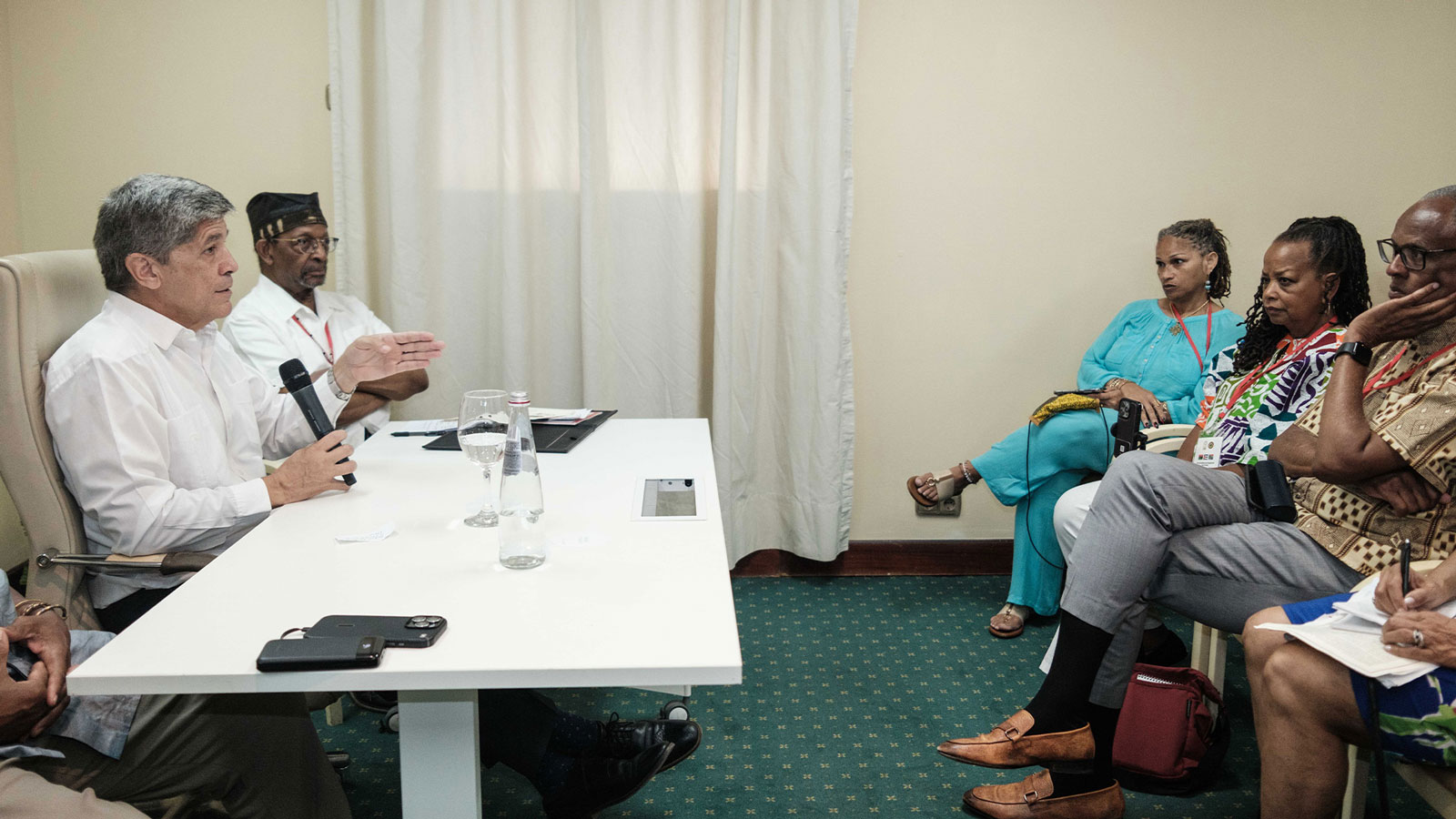
Delegation meeting with Deputy Foreign Minister Carlos Fernández de Cossío. Photo by Bill Lee.
The Deputy Foreign Minister also noted that the Cuban Revolution has achieved the most social-economic development of any nation in Latin America with free, quality health care, free education and free housing for all of its citizens and one of the most highly developed health care systems in the world – with Cuban doctors spreading out all over the developing world in Africa, the Caribbean, Central and South America to provide vital medical and health care services.
The Deputy Foreign Minister noted in passing that he was a soldier among the Cuban troops who fought side by side with the liberation forces of Angola in the decisive defeat of the South African Military in battle of Cuito Cuanavale which led to liberation of South Africa from Apartheid rule! The Deputy Foreign Minister’s extraordinary presentation raised the question: Why such cruelty against Cuba from the USA?
For most delegations to Cuba, the meeting with the Deputy Foreign Minister would have been the highlight. But in a preparatory meeting with H.E., Lianys Torres Rivera, Cuba’s Ambassador to the U.S., we were advised that our Delegation was viewed as being of the highest importance in terms of witnessing the severity of the crisis on the ground and returning to share our observations with key leaders in Black America and the nation. Hence, we were honored to be informed that our Delegation would be received by H.E. Miquel Diaz-Canel, President of the Republic of Cuba.
In an hour-long matter of fact but passionate presentation, the President recounted the accomplishments of the Revolution and Cuba’s contributions to the developing world. He lamented that the 67-year blockade had stunted Cuba’s potential to achieve even more substantial benefits for the Cuban people and the developing world. The Cuban people have survived and achieved despite the blockade, but the most recent obsession with regime change through a crippling embargo on fuel and economic sanctions has precipitated the most severe crisis in the history of the Revolution in terms of the pain suffered by the Cuban people.
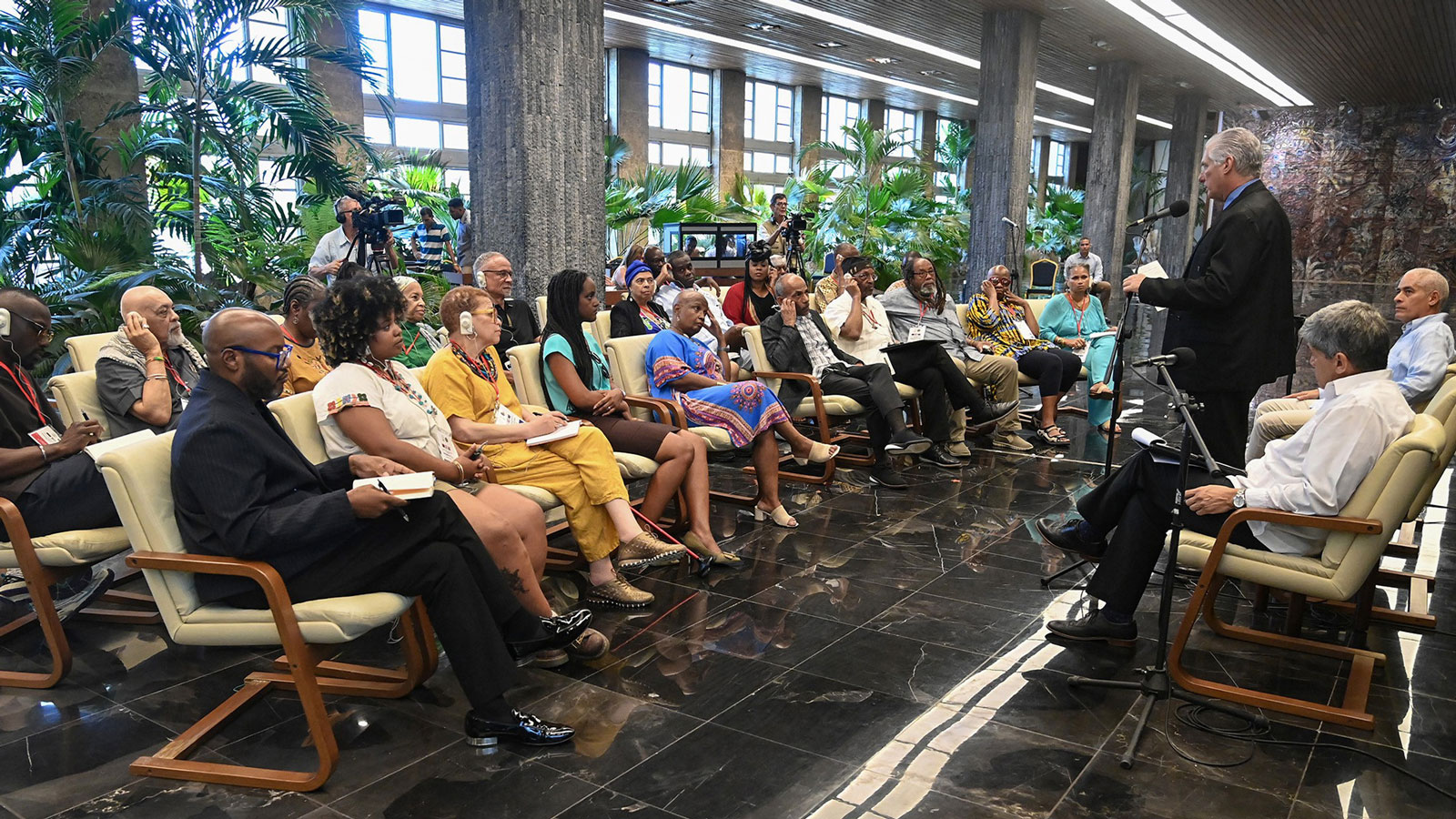
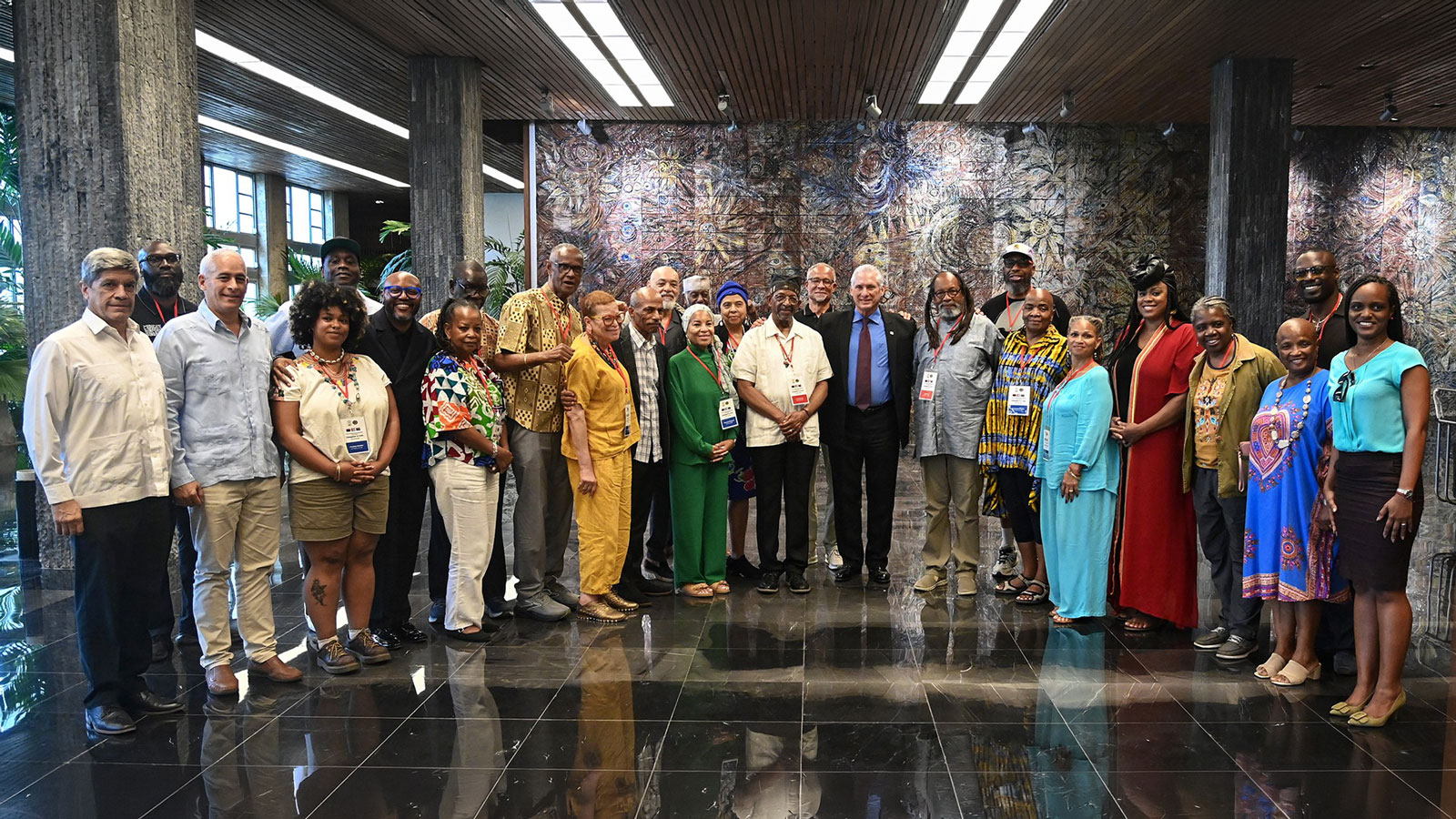
Presidential listening session with President Miguel Díaz-Canel and delegation members. Courtesy of the President’s Office.
In yet another memorable moment for our Delegation, the President referenced Secretary of State Marco Rubio’s allegation that the people of Cuba are suffering because the government is incompetent. While the President disputed this allegation, he said: “Because a government is incompetent does not justify an invasion of a sovereign nation or collective punishment of its people.” Once again, the lingering question of why the cruelty by the USA toward Cuba. President Diaz-Canel made it abundantly clear that he is open to discussing all issues and differences with the U.S. through diplomacy without conditions.
Lest our Delegation depart Cuba without understanding how people power and Cuba’s form of participatory democracy work, we were hosted by the Honorable Esteban Lazo Hernandez, a tall, imposing and visibly proud Afro-Cuban President of the National Assembly of the People’s Power. In U.S. parlance Mr. Lazo Hernandez is the equivalent of Speaker of the House of Representatives.
The President of the Assembly asked for our indulgence, indicating that he needed sufficient time to do justice to a presentation about the role of the people in the decision-making, policy-making process in Cuba. He then proceeded to offer a 90-minute fact-filled, empirically based tutorial on the accomplishments of the Revolution in education, healthcare, medicine, housing and culture, followed by detailed data on the enormous damage and suffering the blockade, embargo on fuel and sanctions are inflicting on the Cuban people. An impressive assembly of officials and deputies were called upon to supplement the President’s remarkable presentation.
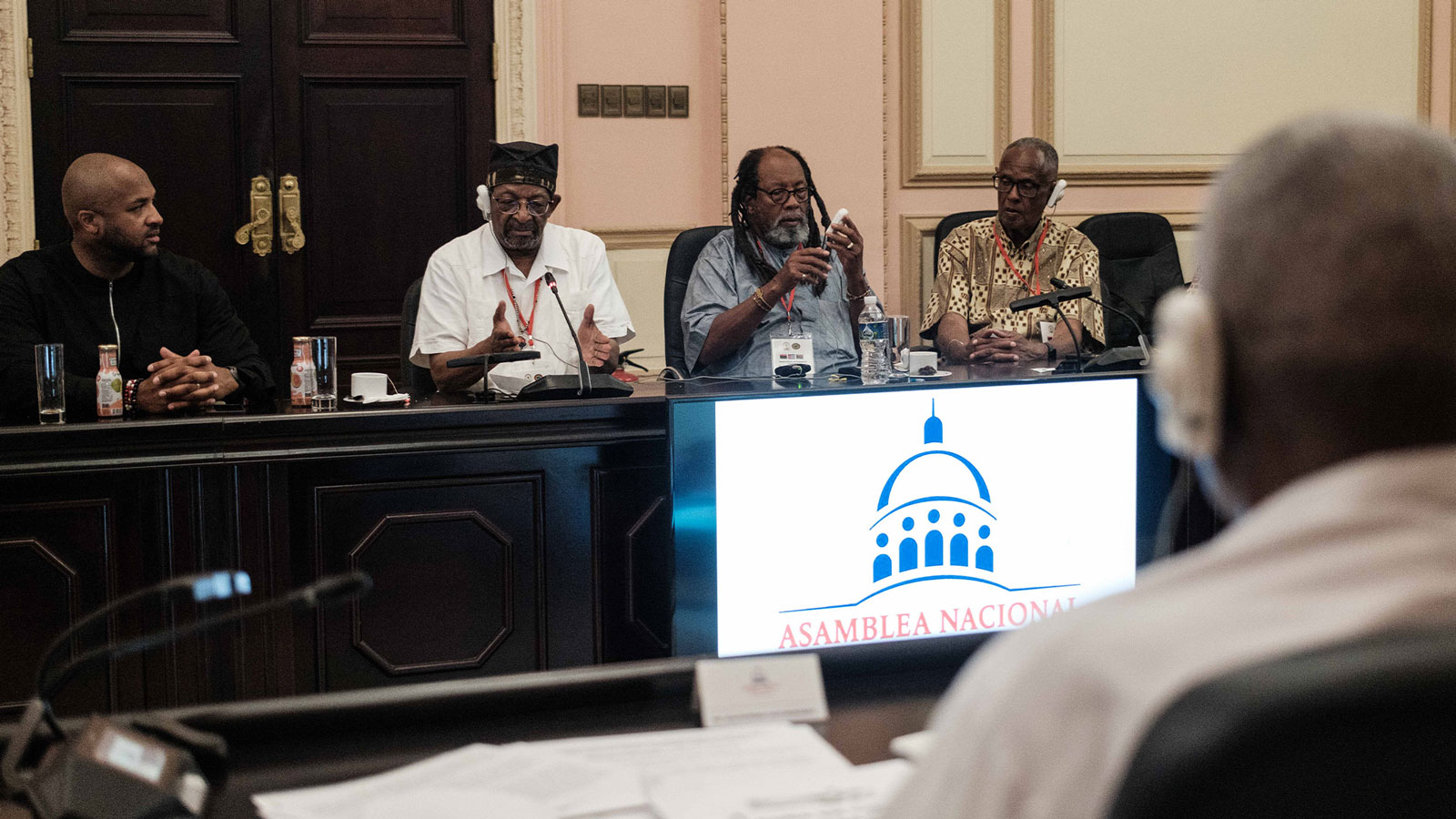
Legislative exchange at the National Assembly. Photo by Bill Lee.
In a heartfelt appeal for mutual solidarity, the President called for an exchange of visits between members of the Congressional Black Caucus, African American Mayors and State Legislators to share experiences on how best to advance the aspirations of our respective peoples in pursuit of people-based, social-economic development. Finally, the President reiterated the call by President of the Republic Miguel Diaz-Canel for normalization of relations based on the Obama Accords with the U.S. without conditions.
The issue of racism and racial discrimination as it impacts Afro-Descendants was a major matter of interest and inquiry for our Delegation. One of Fidel Castro’s first acts of the Revolution was to declare Cuba an Afro-Hispanic Nation because of the composition of the population (by US standards 50% of the Cuban population would be designated Black) and the People’s Assembly of Power banned racial discrimination as a matter of law. Afro-Cubans also hold positions at the highest levels of power within the Communist Party, the Government and agencies and institutions within Cuban society. Notwithstanding these facts, Afro-Cubans still experience racial discrimination and are disproportionately impacted by inequities in health, educational achievement, employment, economic development and imprisonment.
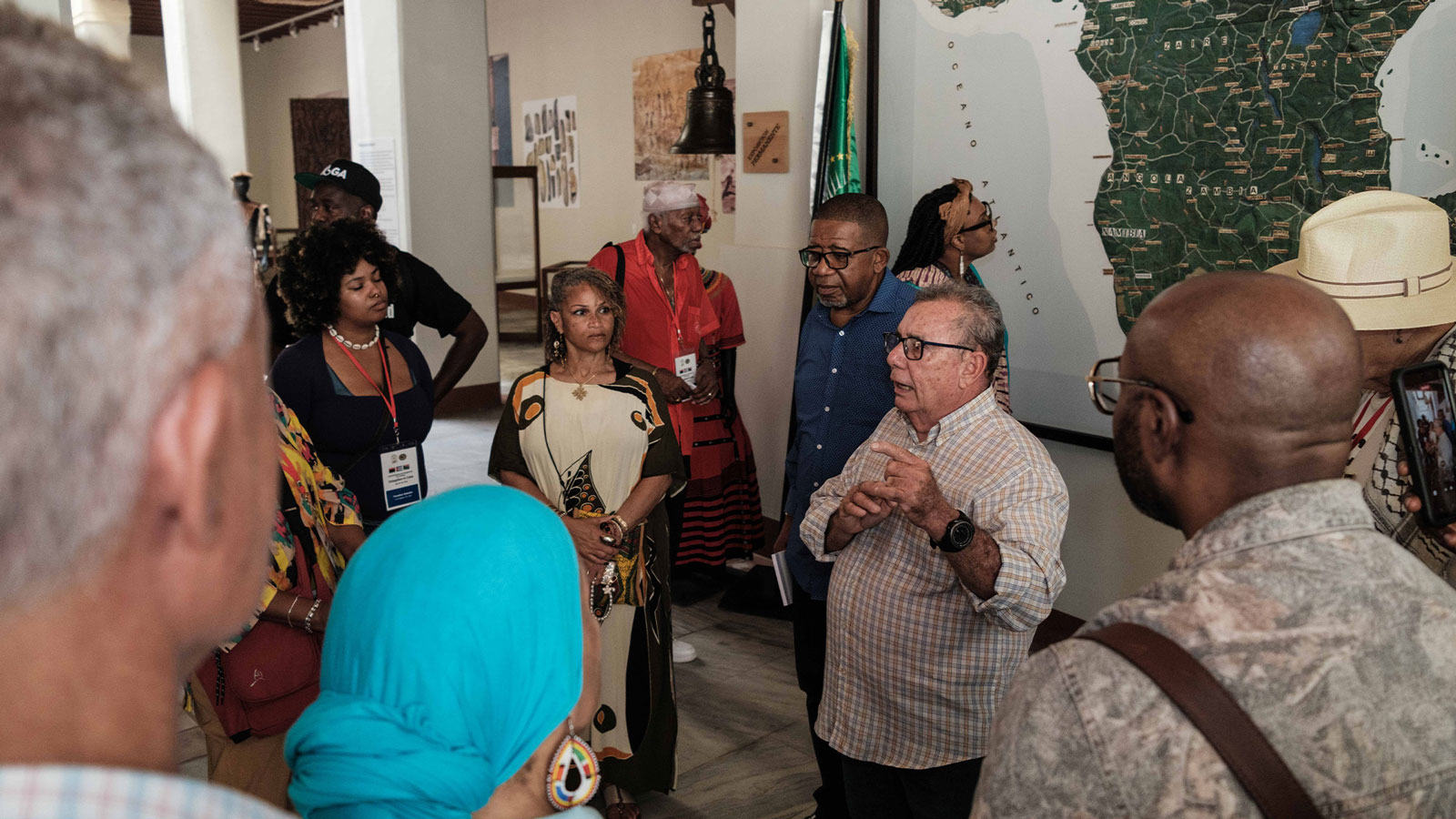
Delegation tour of Casa de África in Old Havana led by Alberto Granado Duque, Director of Casa de África. Photo by Bill Lee.
At Cuba’s renowned Africa House in Havana, our Delegation heard from outstanding scholars who detailed the cross-generational evolution and imbedding of racism in Cuban culture. Rolando Rensoli Medina, who is the Chairman of the Commission on Racism shared how Afro-Descendants were the backbone of each of Cuba’s wars of independence. Unfortunately, their service was not rewarded with equitable status once independence was finally won. It was the Euro-Hispanic elites who seized the reins of power to the exclusion of Afro-Descendants, thereby entrenching racism in the systems of Cuban society and the attitudes of privileged sectors of the population. In summary, the challenge and mandate of the Revolution is to overcome these factors. Medina emphasized that: “The Party Is not racist, the Government is not racist, some of the people still carry racist attitudes.” While all of the presenters are devoted to eradicating racism in Cuban society, they are pursuing this cause as supporters of the Revolution.
On the matter of racism in Cuban society, it is important to note how much Africa is central to the psyche of the nation. We observed that at virtually every stop on our itinerary African history and culture and the commitment to support Africa and African people was emphasized in one manner or another. And it is notable that even lighter skinned Afro-Descendants and Euro-Hispanics embrace Africa and identify as African.
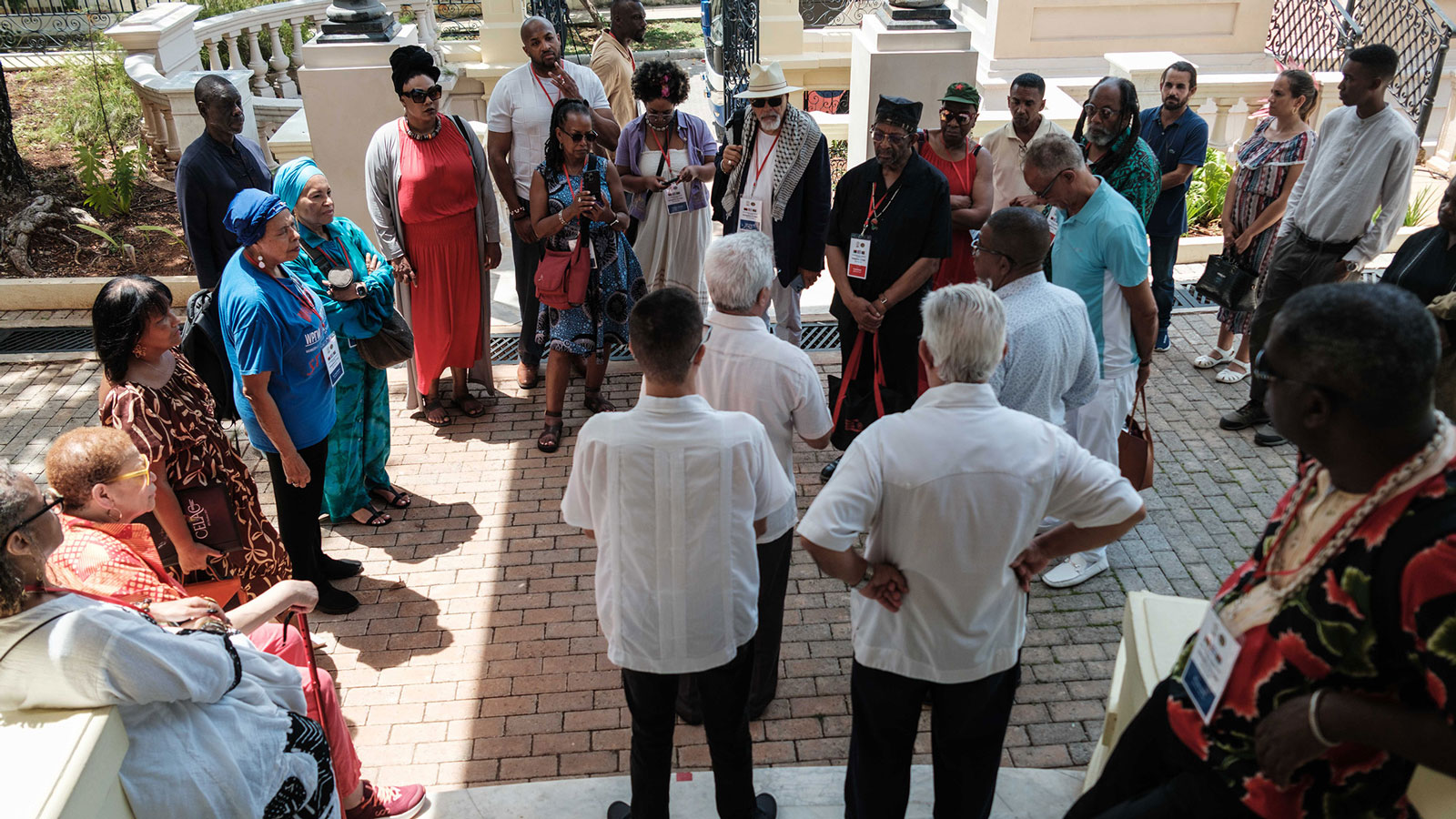
Visit to Centro Fidel Castro. Photo by Bill Lee.
Our visit to the Fidel Castro House was another informative and impactful experience, particularly in terms of learning about Fidel’s principled and vehement rejection of the cult of personality. Fidel would not allow his image to be posted anywhere in Cuba or for any statutes or monuments to be erected in his honor. The educational exhibits in the Castro House clearly illustrate Fidel’s evolution and development as an inspired and inspirational servant leader!
That proud commitment to serving the people in Cuba and the world is a trait that we observed over and over again during our experience in the sovereign Republic of Cuba. Which compels us to confront the crucial question posed in the Op-Ed piece authored by Congressman Jackson and Congresswoman Jayapal: Why the cruelty of U.S. policy toward Cuba?
Speaking as the Convener of the Delegation, I conclude that it is the very idea of Cuba as people-based, people-oriented nation with such notable achievements despite the hostile blockade and embargo that is a threat to the racialized system of Capitalism in the U.S. It would appear that successive administrations would prefer the good old days of Cuba as the domain of a Euro-Hispanic privileged elite and playground for mobsters and the rich and the famous under the corrupt, dictatorial U.S. backed regime of Fulgencio Batista.
Perhaps, the lesson our Delegation learned from our experience in Cuba is that we should be inspired to fight for a system of governance and democracy in the U.S. that will guarantee that every child in the nation will have at least one liter of milk a month! It’s time to break the stranglehold of the Cuban Lobby in South Florida so that the idea of Cuba can flower and flourish within the context of the normalization of relations based on the Obama Accords! Our mandate is to devise a strategy to educate, organize and advocate to achieve this righteous objective. It must be a priority for our Black Agenda!
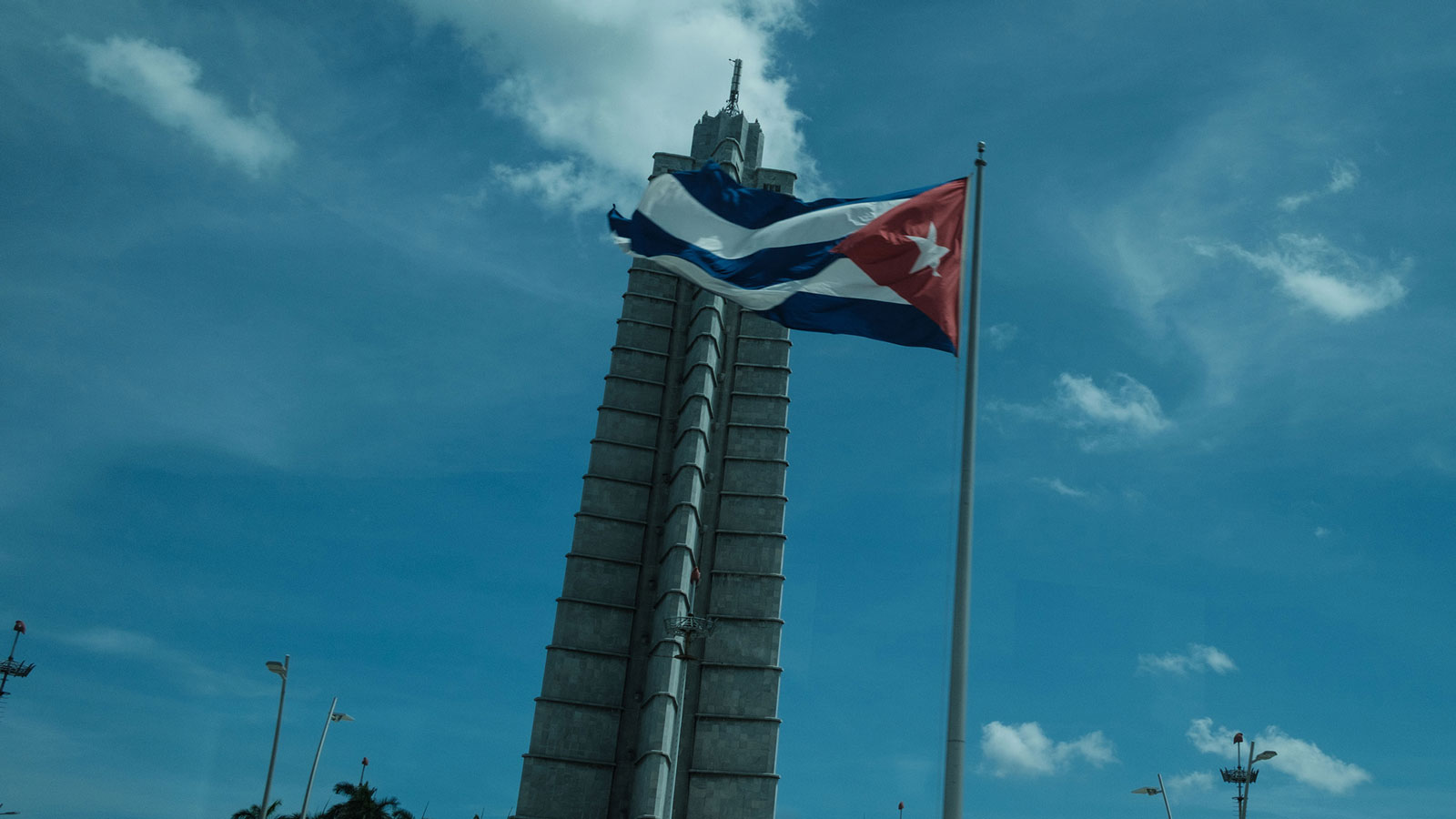
Cuban flag flying in Havana. Photo by Bill Lee.
Back to Top ↑
Action Agenda
Mutual Solidarity and Engagement Assistance
- The Commitment to a campaign to mobilize urgently needed humanitarian assistance as specified by various agencies, institutions and organizations on the ground in Cuba to be channeled through Pastors for Peace in the U.S. in partnership with the Martin Luther King Center in Cuba in honor of Rev. Dr. Lucius Walker. Request implementation by the Progressive National Baptist Convention and Black Family Summit affiliated organization with support of IBW/PAUD
- Outreach to the National Medical Association to ensure the organization is connected with the public health system in Cuba to provide support. Request implemented by the Association of Black Psychologists
- Explore ways of raising resources to supplement the stipends for students at the famed Latin American School of the America’s Scholarship Program which provides free education and degrees in various fields of medicine for students from the United States. Students often need additional funds for transportation, food and extracurricular activities. Implementation, TBA
- Encourage the adoption of Neighborhood Community Centers like the Karibuni Community Center which we visited to provide material support as requested by the leadership to enhance the capacity of these Centers to provide a wide range of services to support citizens in the community. Request Implementation by Black Family Summit affiliated organizations.
- Encourage African American civil rights, human rights, faith, cultural, labor, business and professional, Greek Letter and civic organizations to convene board meetings in Cuba. Implementation by IBW/PAUD
- Promote cultural-historical tourism with a focus on the history, culture and contributions to Cuba by Afro-Cubans. Implementation by IBW/PAUD
- Encourage a visit by an African American Women’s Delegation for a Dialogue with Afro-Cuban Women to share experiences in the struggle to overcome gender-based bias within the context of their respective struggles for liberation. Implementation by Dr. Julianne Malveaux
- Encourage the building of relationships between Psychiatrists, Psychologists, Counselors and medical personnel at the Hermanos Ameijeiras Clinical Surgical Hospital to explore culturally-appropriate methods of psychological counselling and support for patients, staff and community residents. Implementation by Association of Black Psychologists and National Association of Black Social Workers
Normalizing Relation with Cuba Based on the Obama Accords
Political Education, Mobilization and Engagement in the U.S.
- Request data filled presentation by the Honorable President of the Cuban Assembly on achievements of the Cuban Revolution and the debilitating effects of the U.S. Government imposed blockade and sanctions. Implementation by IBW/PAUD
- Delegation of African American civil rights, human rights and legal experts and their Cuban counterparts for a dialogue on the state of racial discrimination in the U.S. and Cuba with the objective of sharing policies to eliminate racism in the U.S. and Cuba. Request Implementation by the National Action Network
- Delegation of African, Caribbean and African American Mayors for mutual exchange of information with Cuban legislators. Request Implementation by Hon. Johnny Ford, President, World Conference of Mayors and Hon. Ras J. Baraka, Mayor of Newark
- Delegation of African American State legislators for mutual exchange with their counterparts in Cuba. Request implementation by New York State Senator James Sanders
- Encourage dialogue and exchange of experiences between young Pan Africanist and internationalist advocates, organizers, scholars, artists and cultural workers in the U.S. and Cuba for the purposes of strengthening mutual solidarity. Request implementation by Black Lives Matter Grassroots.
- Arranging a major forum on the crisis in Cuba and normalization of relations during the Annual Congressional Black Caucus Foundation, Inc’s Legislative Conference featuring governmental officials and civil society leaders from Cuba. Implementation by IBW/PAUD
- Facilitating appearances at conferences and conventions of civil rights, faith, Labor and political organizations and associations to share the story of the successes of the Cuban Revolution, contributions to Africa and the Pan African world as part of the process of building a formidable constituency for normalization of relations with Cuba in the U.S. Implementation by IBW/PAUD
- Devising a civic education and engagement strategy to break the grip of Cuban constituencies in Florida on U.S. policy towards Cuba anchored in a crippling blockade and punitive sanctions. Implementation by IBW/PAUD
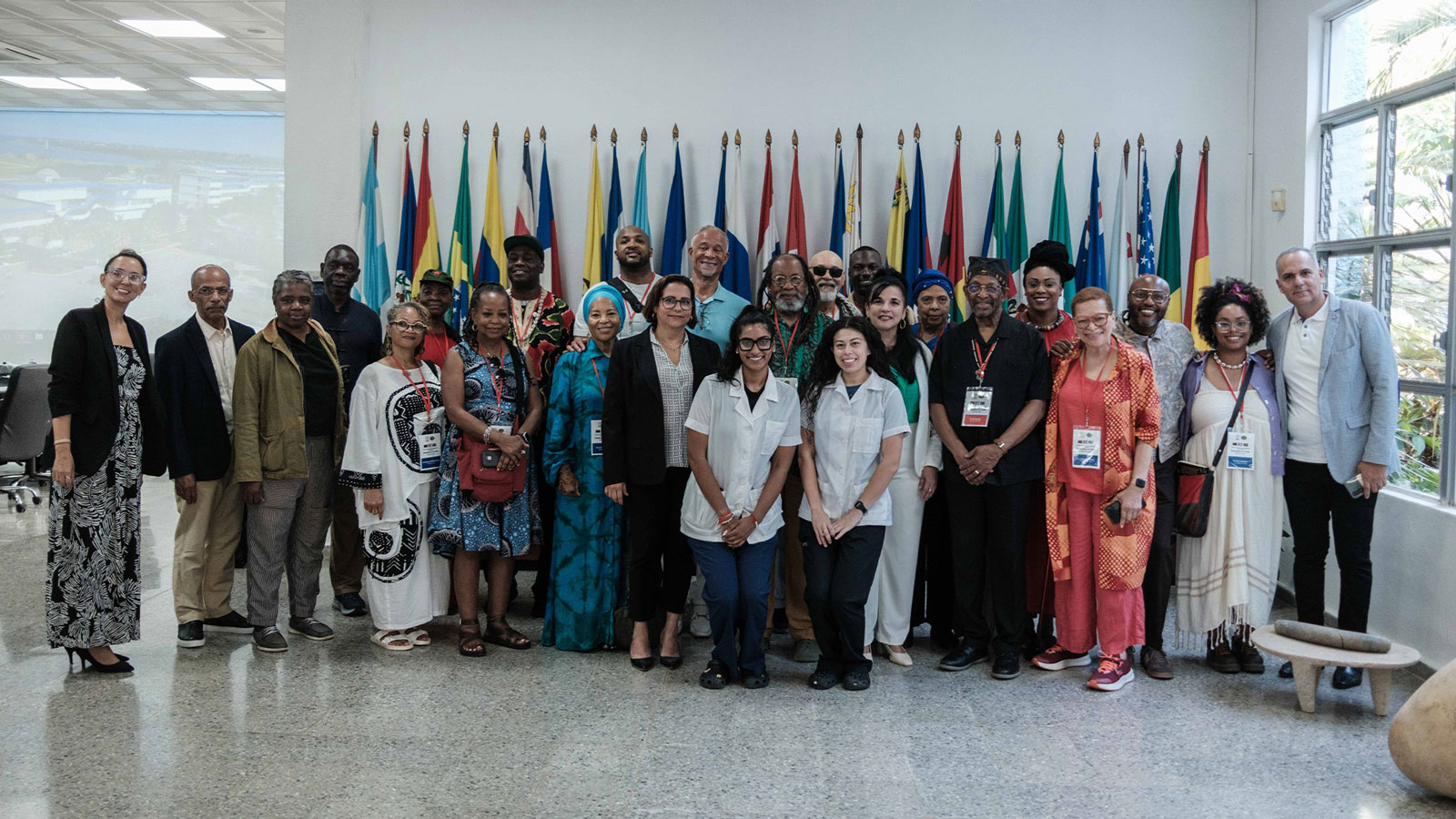
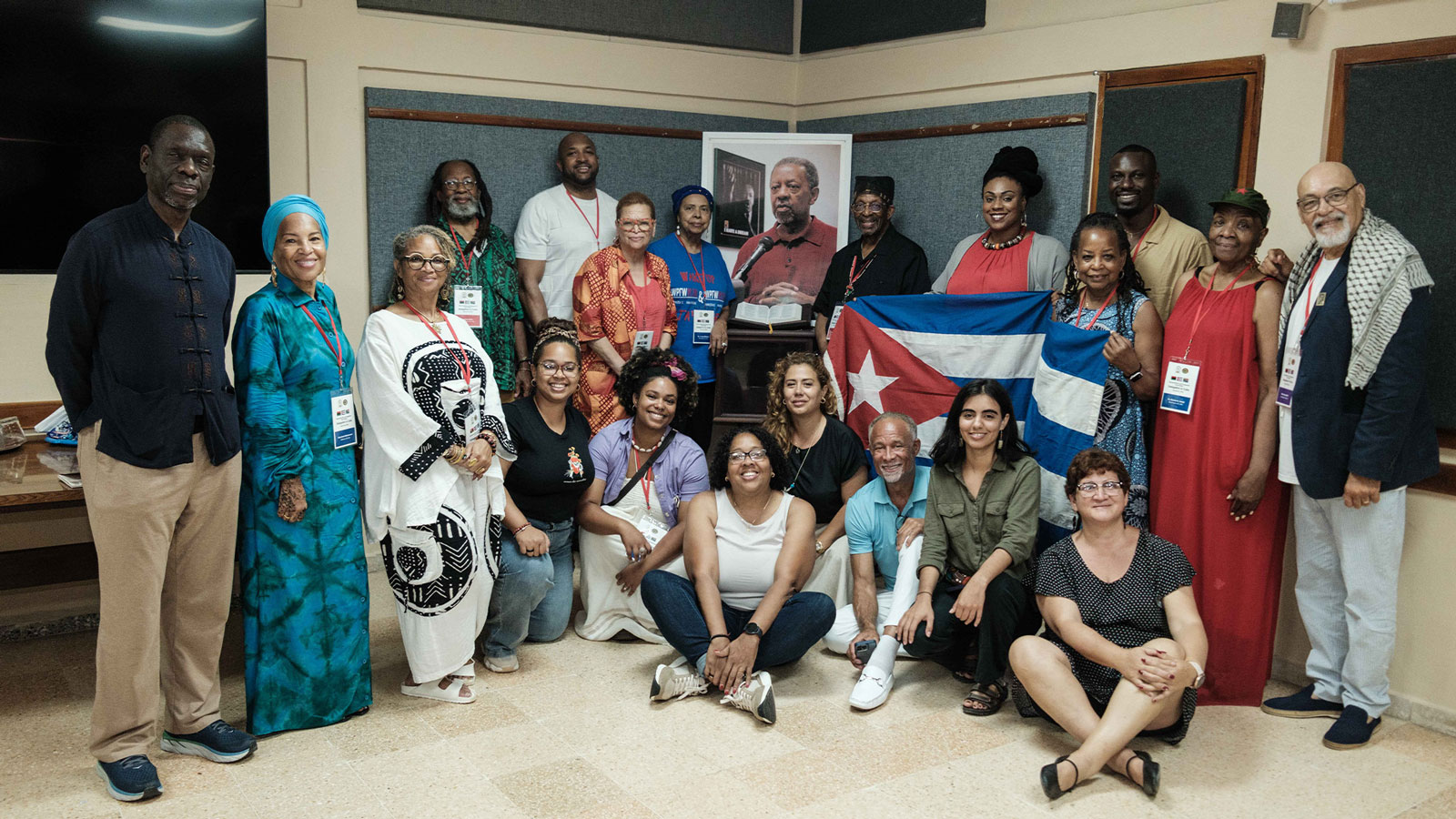
May 2026 IBW/PAUD Delegation visits the Latin American School of Medicine (ELAM), Havana, Cuba. Photo by Bill Lee.
Back to Top ↑
May 2026 IBW/PAUD Delegation
Dr. Ron Daniels
President, Institute of the Black World 21st Century (IBW) / Convener, PAUD
New York, NY, USA
James Early
Cultural Democracy and Statecraft Heritage Policy, Washington, DC, USA
Louis Romain
Institute of the Black World 21st Century / PAUD, Mount Vernon, NY, USA
Dr. Julianne Malveaux
Political Economist; President Emerita, Bennett College for Women
Washington, DC, USA
Dr. E. Faye Williams
World Conference of Mayors
Washington, DC, USA
Mel Foote
President, Constituency for Africa, Washington, DC, USA
Dr. Johnny Mack
National Action Network
Atlanta, GA, USA
Dr. Monique Swift Muhammad
President, National Association of Black Psychologists
Newark, NJ, USA
Dr. Renata H. Jones
President, National Association of Black Social Workers, Washington, DC, USA
Kim Poole
Founder, Executive Director, Teaching Artist Institute, Baltimore, MD, USA
Michael Spencer
Independent Media Professional
Baltimore, MD, USA
Baba Greg Akili
Black Lives Matter Grassroots
Los Angeles, CA, USA
Thandiwe Abdullah
Black Lives Matter Youth Vanguard
Los Angeles, CA, USA
Herb Boyd
Senior Writer, Amsterdam News
New York, NY, USA
Denise Rolark Barnes
Publisher, The Washington Informer
Washington, DC, USA
Nisa Islam Muhammed
Staff Writer, The Final Call
Baltimore, MD, USA
Dr. Nii Quartelai Quartey
Radio Host, KBLA Talk 1580
Los Angeles, CA, USA
Rev. Bill Lee
Freelance Photographer
Baltimore, MD, USA
Milton Allimadi
sher, Black Star News / Crisis in Africa and Caribbean Task Force
New York, NY, USA
Dr. Haki Ammi
Institute of the Black World 21st Century, Baltimore, MD, USA
Linton Hinds
Host, I Never Knew TV
Philadelphia, PA, USA
Rev. Dr. Robert Turner
Senior Pastor, Empowerment Temple AME Church, Baltimore, MD, USA
Rev. Darryl Gray
Progressive National Baptist Convention / Rainbow PUSH Coalition
St. Louis, MO, USA
Karen Carrillo
Senior Staff Writer, Amsterdam News
New York, NY, USA
***
Regrets
The following individuals confirmed their participation in the May 2026 delegation but were unable to attend.
Justin Hansford, Esq.
United Nations Permanent Forum on People of African Descent,
Washington D.C., USA
Dr. Lesli Baskerville
National Association for Equal Opportunity in Higher Education (NAFEO), Washington D.C., USA
Sen. James Sanders Jr.
New York State Senator
Queens, NY
Mayor Barbara Lee
Mayor, Oakland, CA, USA
Maurice Mitchell
National Director, Working Families Party, Long Beach, NY, USA
Back to Top ↑
Featured image: President Miguel Díaz-Canel with IBW/PAUD Delegation. Havana, Cuba • May 30, 2026. Photo courtesy of the President’s Office.