NEW YORK, NY — The Pan African Unity Dialogue (PAUD) today called on leading African American elected officials, legacy civil rights organizations and faith leaders to publicly oppose calls by U.S. Senator Lindsey Graham and U.S. Secretary of State Marco Rubio suggesting that Cuba should be the next target of U.S. backed regime change.
PAUD urged prominent Black organization including the Congressional Black Caucus, NAACP, National Action Network, Rainbow/PUSH Coalition and the National Urban League along with African American faith leaders nationwide to denounce any policy that could lead to war, destabilization or further economic hardship for the Cuban people.
“Senator Graham’s statement that ‘Cuba’s next’ and ‘their days are numbered,’ following the launch of the Israel – U.S. attack on Iran, is reckless warmongering,” said Dr. Ron Daniels, President of the Institute of the Black World 21st Century and convenor of PAUD. “The Cuban people have endured tremendous hardship under the illegal U.S. embargo imposed in 1960. Now, the U.S. government has tightened pressure on Cuba by cutting off access to oil supplies from Venezuela and is threatening sanctions against other countries willing to assist the island nation. I believe it’s time for dialogue to find a respectful diplomatic solution. In fact, Black leaders and people of good will should press the Trump administration to continue rather than reject the process of normalizing relations with Cuba initiated by President Barack Obama,” Dr. Daniels continued.
Numerous experts on western hemispheric affairs have warned that Cuba’s economy is on the verge of collapse due to the cut off of oil from Venezuela. They warn that an assault on Cuba could precipitate a total economic breakdown which would likely trigger a humanitarian catastrophe that would result in tens of thousands of Cubans fleeing or attempting to flee to the United States and other nations in the region.
“Rather than regime change, the United States should engage in negotiations to lift sanctions and the embargo and move toward full normalization of relations,” said Melvin Foote, founder and President of Constituency for Africa (CFA), the Washington, D.C. based nonprofit that has worked for 40 years to strengthen U.S. Africa relations.
“The U.S. has fundamental ideological disagreements with the People’s Republic of China, which has a communist government. Yet the two countries maintain diplomatic relations, their leaders meet regularly to address differences, and bilateral trade between them totals billions of dollars annually. This is the type of mutual, win-win relationship the United States should pursue with Cuba,” Mr. Foote added.
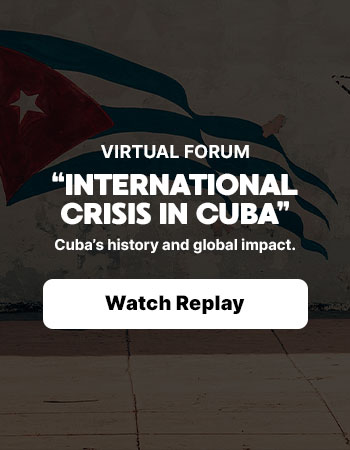
Dr. Daniels urged Black leaders to recall the long history of solidarity between Cuba and the African diaspora. This history was a point of emphasis during a recent forum on International Crisis in Cuba: Building Solidarity in the U.S. and the Global African World, hosted by PAUD:
- After ousting the U.S. backed dictatorship of Fulgencio Batista, one of the first acts declared by the Cuban revolution under the leadership of Fidel Castro was to declare Cuba an Afro-Hispanic nation in recognition of the large number of African descendants in the population and to ban discrimination against Black Cubans.
- In 1960, Fidel Castro made a historic visit to Harlem while in New York for the UN General Assembly, where he stayed at the Theresa Hotel and met with Malcolm X.
- Civil Rights/Human Rights icon Rev. Jesse L. Jackson traveled to Cuba to meet with Fidel Castro in an effort to ease tensions between the U.S. and Cuba.
- Upon his release after 27 years of incarceration by the apartheid regime, the first country outside Africa that Nelson Mandela visited was Cuba to thank the nation for its decisive support in the struggle against apartheid, including the defeat of South African forces at the Battle of Cuito Cuanavale in 1987 in Angola
- Cuba’s support for African and African American liberation struggles, including providing sanctuary to activists in the Black Liberation struggle such as Assata Shakur, the training of thousands of African American and African doctors and engineers in Cuba, and the role Cuban doctors and healthcare workers played in assisting African countries during the Ebola and COVID-19 pandemics.
“Cuba has shown a firm and steadfast commitment to Black liberation, dignity, and progress,” Allimadi added. “Now is the time for African Americans to stand up for Cuba. We call on Black Leaders to emphatically declare: No to war on Cuba and no to regime change.”
The Pan African Unity Dialogue (PAUD) is a broad-based umbrella formation committed to Unity, Cooperation and Action among Continental Africans, Caribbean Americans, Afro-Descendants from Central and South America and African Americans. PAUD is an initiative of the Institute of the Black World 21st Century.
For additional background and context:
Related Article
 Trump’s Brazen Capture of Maduro: A “Dress Rehearsal” for an Assault on Cuba
Vantage Point Article by Dr. Ron Daniels — The Institute of the Black World 21st Century joins the overwhelming chorus of voices of heads of state, elected officials and civil society organizations around the world in condemning the military assault on the sovereign nation of Venezuela and the capture of President Nicolas Maduro. [READ ARTICLE]
Related Forum
International Crisis in Cuba: Building Solidarity in the U.S. and the Global African World
A virtual forum convened by the Pan African Unity Dialogue (PAUD) of the Institute of the Black World (IBW/IBW21), examining Cuba’s role in the global struggle for freedom, sovereignty, and self-determination across the U.S. and the Global African World.