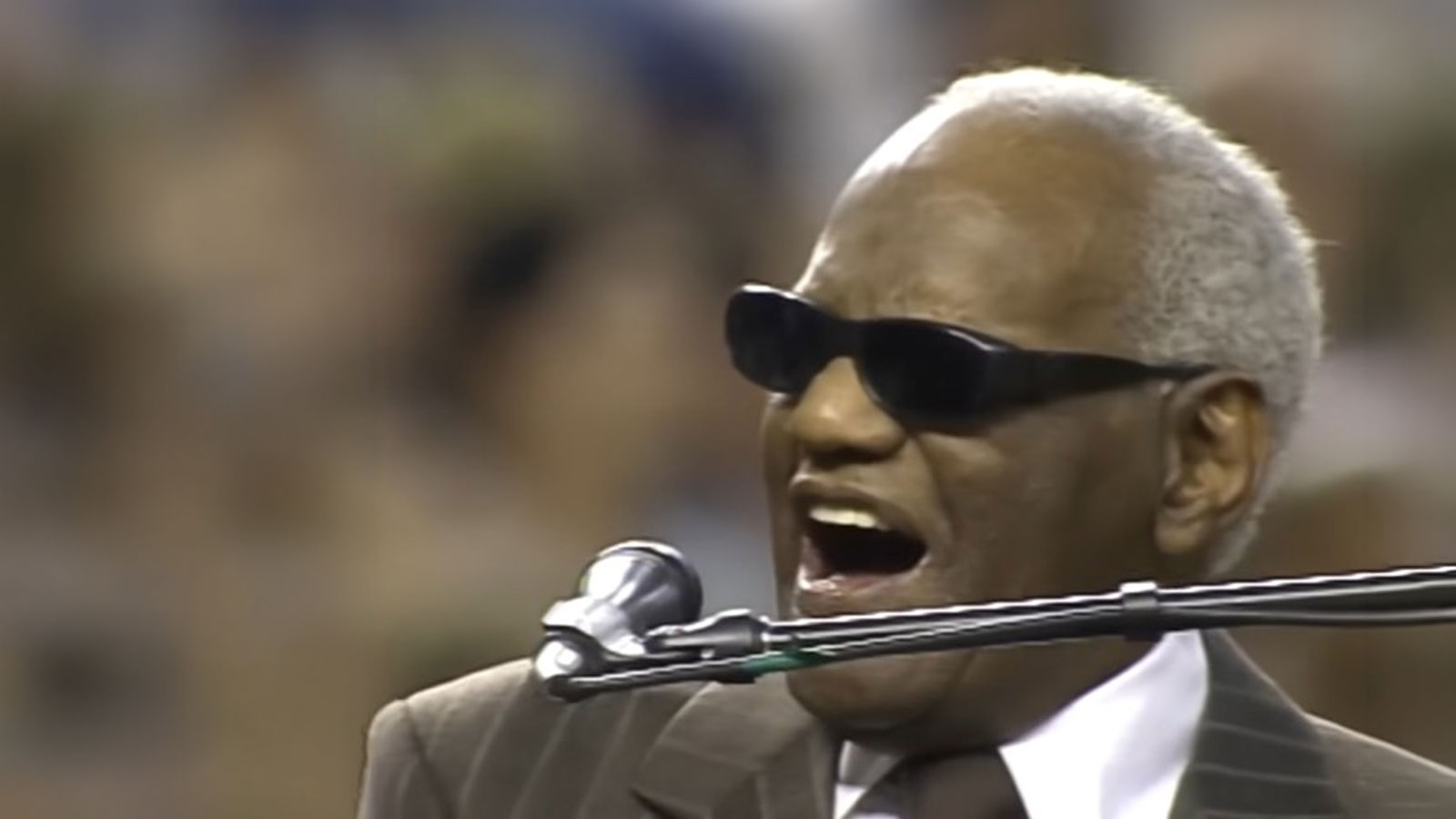
It was Oct. 28, 2001, less than two months after the Sept. 11 terrorist attacks on the Pentagon in Virginia and the World Trade Center in New York City. Yankee Stadium was packed with more than 40,000 baseball fans as the second game of the World Series was about to be played – the New York Yankees vs. the Arizona Diamond Backs.
With the deaths of nearly 3,000 people, including 344 New York firefighters weighing heavily on the hearts and minds of Americans across the nation, the atmosphere was somber and pensive as the players lined up, hats over their hearts, and the audience looked on. Then came the voice of the announcer: “Ladies and gentlemen, to honor America with the singing of ‘America the Beautiful’, please welcome the man and his soul, Mr. Ray Charles!”
Charles’ powerful voice and the soul-stirring melody of his masterful piano-playing electrified the stadium. Rocking side to side in his iconic way, he appeared to sing the words with every fiber of his being. Narrating for a moment, he recalled the words of the song from his childhood: “America! America! God shed his grace on thee…He crowned thy good with every brotherhood from sea to shining sea!”
At the end of the song, he invited the audience to sing along. The crescendo, like no other moment in American history; included a huge flag draping the field, a U. S. Airforce four-jet fly over, a sustained standing ovation and cheers that appeared to melt away tensions and even begin the healing of the nation.
Revisiting this scene nearly 25 years later during Black Music Month 2026, it is striking to observe that despite the vastly White audience, it was the blind grandson of formerly enslaved Black people whose singing of his love for America helped to begin the healing of the nation in that historic moment.
Some people may have questioned how the now late Ray Charles could have embraced that moment with such endearment for a nation that had also, less than two months earlier, begrudgingly participated in the World Conference Against Racism in Durban, South Africa. During his career, Charles had personally refused to perform for segregated audiences and described racism and poverty as “two scourges that I have known since early in my life.”
Dr. Martin Luther King Jr. used to say, “There can be no great disappointment where there is no great love.”
In Ray Charles’ soulful singing about the “amber waves of grain”, perhaps he was drawing from his knowledge of how this nation was built on the backs of his ancestors toiling in the fields day after day.
Perhaps academic and author Michael Eric Dyson said it best in his book, “Entertaining Race”:
Dr. Dyson wrote, “We have entertained the country with our gifts and used those gifts to entertain the idea of race, indeed, the idea of America, with a redemptive love that is both unquenchable and nearly incomprehensible.
This article is the third in a four-part series powered by AARP in commemoration of Black Music Month, June 2026.